
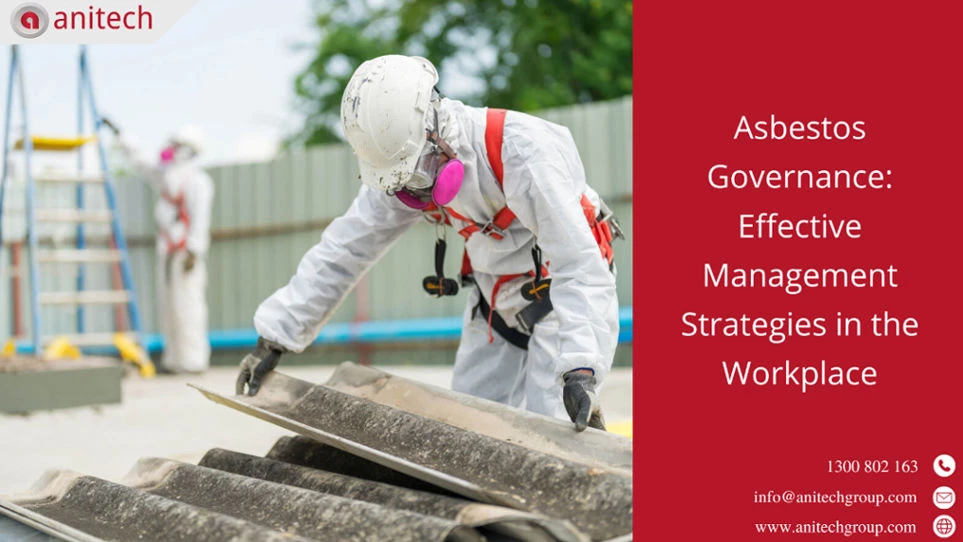
Within the sphere of workplace safety, asbestos governance emerges as a pivotal facet, requiring meticulous management strategies to protect the welfare of workers and alleviate potential risks.
Our exclusive guide on Effective Management Strategies in the Workplace serves as a comprehensive guideline for businesses grappling with asbestos-related challenges.
The blog also navigates the intricate landscape of asbestos management in present-day workplaces, offering insights into tailored and effective strategies for organisations.
Asbestos Risk Assessment
Effectively managing asbestos risks involves a systematic approach that encompasses several key steps.
Below given are the key steps to perform an asbestos risk assessment:
1) Identification of Asbestos:
Thoroughly identify asbestos and asbestos-containing materials (ACM) within the workplace.
2) Documentation in Asbestos Register:
Maintain a comprehensive asbestos register that meticulously records all identified materials for reference.
3) Risk Assessment:
Conduct a detailed assessment to gauge the risk of exposure to airborne asbestos fibers, considering the potential impact on individuals.
4) Implementation of Control Measures:
Employ stringent control measures to either eliminate or minimize the risks associated with asbestos fiber exposure.
5) Regular Review of Control Measures:
Periodically review and assess the effectiveness of implemented control measures to ensure their continued efficacy in safeguarding against asbestos-related risks.
Asbestos Registers
To effectively manage asbestos within your workplace, it is imperative to create and maintain a comprehensive asbestos register. This document is essential if asbestos or asbestos-containing material (ACM) is present, assumed to be present, or likely to be present at any given time.
Here are the key requirements:
1) Up-to-date maintenance:
Regularly update the asbestos register to ensure its information remains current.
2) Accessibility:
Keep the asbestos register on-site and easily accessible to workers, health and safety representatives, and other relevant parties. Provide it to the succeeding PCBU taking control of the workplace.
3) Register Content:
Include crucial details such as the date of asbestos identification, type of asbestos, condition of asbestos and ACM, and a thorough description of locations where asbestos is present or likely to be found.
4) Additional Information:
The register may encompass laboratory analysis results, details of uninspected inaccessible areas, and photographic documentation of identified or assumed asbestos and ACM.
5) Site Plans and Photographs:
Enhance the register with site plans and photographs illustrating the specific locations of asbestos and ACM within the workplace.
It’s important to note that if your workplace structure was erected after December 31, 2003 (or after December 31, 1989, in Queensland), and no asbestos or ACM is identified or likely to be present, you are exempt from the requirement of maintaining an asbestos register.
VAEA’s Risk Assessment Model
To methodically prioritise the removal of Asbestos-Containing Materials (ACM) based on risk, the Victorian Asbestos Eradication Agency (VAEA) has devised a specialized asbestos risk assessment model. This model has been developed through extensive consultations with Victorian OHS regulators, occupational hygienists, licensed asbestos removalists, trade unions, and employers.
The VAEA assessment model takes into account critical risk factors, including ACM friability, ACM condition, ACM disturbance potential, and building rating (refer to Figure 1). By assigning a uniform percentage weighting to each of these risk factors, the model produces a consolidated risk score. This approach ensures a consistent and objective evaluation of ACM risk, contributing to a more reliable risk assessment process.
ACM friability and ACM condition collectively account for 50% of the final risk assessment score, derived from the survey assessment of each ACM. The pivotal element in the risk model, ACM friability, carries a weight of 35%, reflecting its significant impact on fiber release risk. Friability is assessed based on a scale corresponding to the ACM product type. The condition of ACMs contributes up to 15% to the overall weighting.
The disturbance potential and building rating risk factors constitute the remaining 50% of the final risk assessment score, considering the built environment surrounding the ACM. Disturbance potential, categorized into four levels, contributes up to 25% of the overall risk score The building rating, is dependent on factors such as building use, public access, nature and frequency of access, building type, and operation of mobile plant equipment, contributes to the remaining 25% of the overall risk score.
Given that there is no recognized safe level of asbestos exposure, each risk factor holds a value contributing to the overall risk score, and no risk factors are assigned a zero score. A precautionary approach is adopted, assigning a higher risk weighting to assumed ACMs when a condition, disturbance potential, or friability is listed as ‘unknown.’
The calculation of the four risk factors and their respective weighting yields a minimum possible risk score of 19 and a maximum possible risk score of 100. Within the AIR System, this risk assessment is automatically applied to ACMs, determining the priority for the removal of each identified ACM.
Asbestos Management Plan
An asbestos management plan is a crucial requirement if asbestos is present within your workplace. The plan should encompass the following elements:
1) Identification Information:
Provide details on the identification of asbestos and ACM, with references or links to the asbestos register and clear indications of signage and labels.
2) Management Strategies:
Articulate how you intend to manage asbestos and ACM, elucidating the rationale behind your decisions. This includes outlining safe work procedures and implementing control measures.
3) Emergency Response Procedures:
Develop procedures for effectively responding to and managing accidents, incidents, or emergencies involving asbestos.
4) Consultation and Training:
Clearly outline procedures for consultation, define responsibilities, and specify information and training requirements for workers engaged in asbestos-related tasks.
Additional Components to Consider:
- Risk Control Outline: Provide an overview of how asbestos risks will be controlled, detailing the specific control measures in place.
- Timetable for Risk Management: Include a timetable for managing exposure risks, incorporating review dates for the asbestos management plan and factors affecting future reviews.
- Responsibility Assignment: Specify individuals responsible under the management plan.
- Air Monitoring Procedures: Outline procedures for air monitoring at the workplace.
It is imperative to make the asbestos management plan readily available to relevant parties. Periodic reviews are necessary:
- At least every 5 years: Ensure ongoing relevance.
- Upon Health and Safety Representative Request: Respond promptly to such requests.
- When Asbestos is Altered: Review the plan if asbestos is removed, disturbed, sealed, or enclosed.
- With Changes to Control Measures: Update the plan when modifications are made to existing control measures.
- As Needed for Enhancement: Initiate a review whenever an improved plan is warranted.
Thus, by diligently following these steps, businesses can proactively mitigate the dangers associated with asbestos, fostering a safer and healthier work environment.
By embracing meticulous identification, strategic planning, and ongoing vigilance, workplaces in Australia and the world can foster a culture of safety that prioritises the health and well-being of every individual involved.
If you want professional help in strategising and implementing an effective Risk Management plan at your workplace, feel free to connect with our expert consultants.
You can call us at 1300 802 163 or e-mail – sales@anitechgroup.com.


Recent Comments