1300802163
 
HomeCategory

Blog

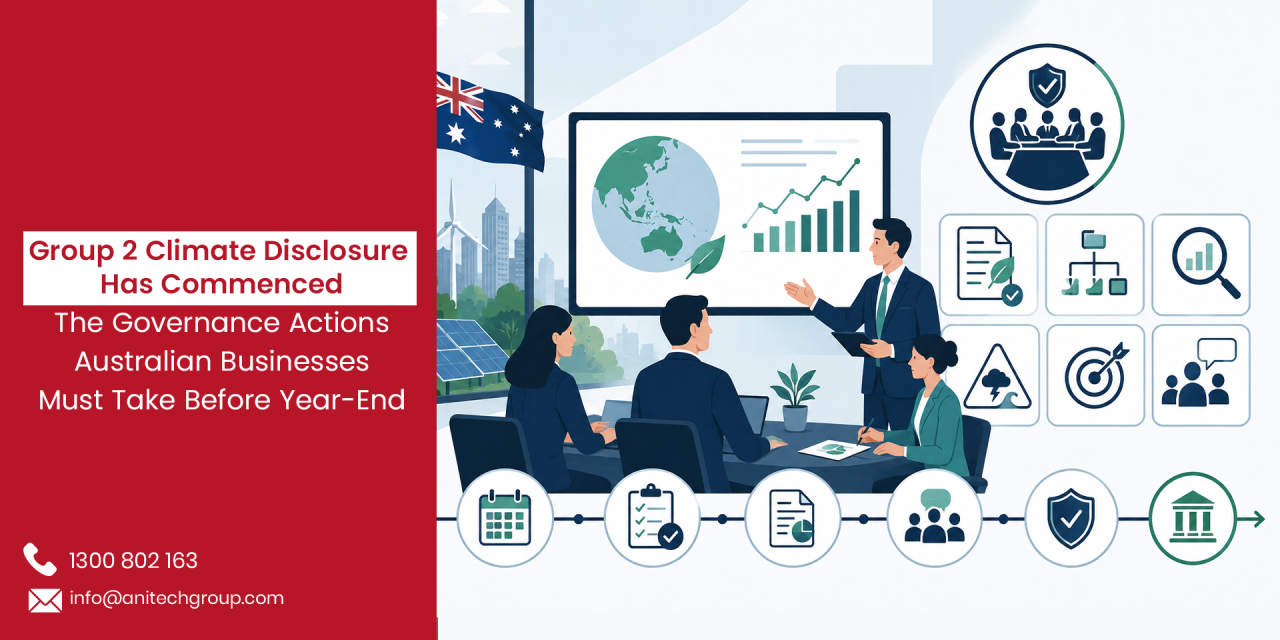
Group 2 Climate Disclosure Has Commenced – The Governance Actions Australian Businesses Must Take Before Year-End

Australia’s mandatory climate reporting regime is no longer a “watch this space” issue. It’s live, and it’s moving through the business population in stages. Group 1 entities, the largest listed companies and financial institutions, have already lodged their first sustainability reports. Now it’s Group 2’s turn, and for a much bigger slice of Australian business,...

Climate-Related Financial Disclosures for Group 2 Entities: June 2026 Preparation for Mandatory Reporting

If your business falls into the Group 2 reporting category, the clock is ticking. From 1 July 2026, Group 2 entities will be required to start reporting climate-related financial disclosures for financial years commencing on or after that date. For most businesses in this category, that means data capture has already started and the first...

Future Made in Australia: Governing Community Benefits Across Sustainable Supply Chains

The Australian businesses that deal with the government-funded projects or other large projects are starting to redefine the playing field. Community benefit is no longer a marginal social issue. It is now a core consideration in governance, risk management, and long-term investment decisions. The explicit embedding of Community Benefit Principles within the Future Made in...

Policy Requirements: How Government Procurement’s Green Mandate Will Reshape Supplier Contracts

The rulebook for winning Australian government contracts has been rewritten. While price, quality, and delivery were once the holy trinity, a new, non-negotiable condition has emerged: a verifiable commitment to sustainability. The Environmentally Sustainable Procurement (ESP) Policy is not a suggestion, it’s a new operating model that will reshape how suppliers compete and win work....

The Ultimate Guide to Operational Resilience: How Australian SMEs Can Survive an Uncertain Economy

Running a small or medium-sized business in Australia today feels like navigating a ship through unpredictable seas. There is a constant juggle from supply chain snarls and cyberattacks to shifting interest rates and sudden market changes. These waves of disruption keep coming. It’s no longer a question of if a crisis will hit, but when....

2025 Mandatory Climate Disclosure: Where Does Your Business Stand?

After Australia’s Securities and Investment Committee, ASIC, adopts climate-related financial reporting in all large-scale enterprises and financial institutions from 1 January 2025, Australia officially enters a new era of corporate responsibility. Even though it’s been six months, many businesses are still having trouble with the practical aspects of climate-related financial reports. While others are already...

Understanding Sustainability: Definition, Principles, and Environmental Impact

In today’s world, sustainability has become a buzzword describing strategies a person or organisation can adopt to better protect the planet. Prominent issues such as climate change, soil degradation, energy access, responsible resource management, waste and pollution are at the forefront of sustainability discussions. It is important to understand the concept of sustainability and its impact...

The Importance of ESG and Sustainability for Your Business

Sustainable success, in any business, depends on the care taken regarding Environmental, Social, and Governance (ESG) policies. These three letters have become more important in recent times for a company’s success, as corporate social responsibly or CSR grow in prominence. This article will examine what exactly ESG is, implementation strategies and benefits a business will...

Mandatory Climate Reporting: Action Required on Australian Businesses

From January 1, 2025, Australia’s Securities and Investment Committee, ASIC, will adopt climate-related financial reporting in all large-scale enterprises and financial institutions. This is a significant step toward sustainability and transparency and aligns well with global efforts towards climate change. Now developers, builders, and stakeholders should all report their qualifications. This reporting initiative stems from...

ESG Report Requirements in Australia and Why Businesses Should Use an ESG Consultant

Introduction ESG reporting, on its part, has gained significant momentum in major industries of the world, including that of Australia. Basically, through ESG reports, stakeholders gain important insights into a company’s attitude toward sustainability, social responsibility, and its form of governance and hence learn how an organization manages its risks and opportunities beyond just financial...