
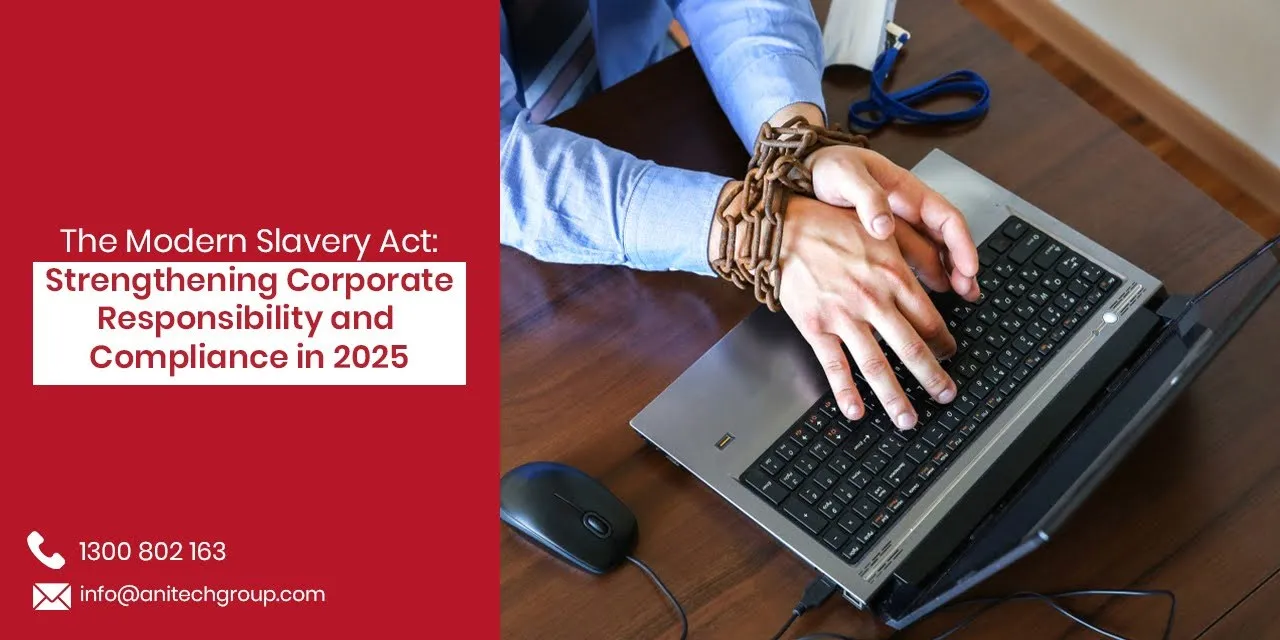
The Australian Federal Police (AFP) reported receiving 382 reports of suspected modern slavery in the 2023–24 financial year. In response, the Australian Government has taken critical steps to strengthen corporate accountability. The latest reforms to the Modern Slavery Act 2018, effective from late 2024, introduce stronger compliance mechanisms and a renewed focus on ethical supply chains for 2025 and beyond.
For businesses across Australia, especially those with complex supply chains or operations overseas, understanding and adhering to these changes is essential. It helps businesses remain compliant and competitive in an increasingly values-driven market. At Anitech, we work with businesses to help them understand and comply with this critical legislation. In this article, we’ve simplified the Act and explained its practical impact on businesses in 2025. Let’s explore how these updates translate into practical business responsibilities.
A Quick Recap: What Is the Modern Slavery Act 2018?
The Modern Slavery Act 2018 was introduced to address serious exploitative practices such as forced labour, human trafficking, debt bondage, and child labour in the operations and supply chains of large Australian entities. It legally required eligible businesses to publicly report how they identify and manage modern slavery risks in their operations and supply chains.
However, until recently, there was no central oversight mechanism, and enforcement was largely reputational. In late 2024, Parliament amended the Act to introduce stronger compliance powers, clearer responsibilities, and a new authority: the Australian Anti-Slavery Commissioner.
Key Changes Businesses Must Know in 2025
Here’s a breakdown of the major legislative changes that businesses must be ready for in 2025:
1. Establishment of the Australian Anti-Slavery Commissioner
One of the most significant reforms is the formal appointment of an independent Commissioner. Their role is to support entities in meeting their obligations under the Act, monitor compliance, issue guidance, and, if necessary, name non-compliant businesses publicly.
This marks a major shift in compliance culture. Compliance is no longer only about publishing a statement; it’s now about demonstrating real commitment to managing modern slavery risks.
2. More Robust Oversight and Enforcement
The Commissioner is now empowered to request explanations and remediation from businesses that fail to meet their obligations. If these are not adequately addressed, the Commissioner may publish the entity’s name and details of the breach.
This shift marks the end of passive compliance; businesses are now expected to act or face real consequences. Failing to meet these requirements may now result in public scrutiny and reputational damage.
3. Clearer Expectations for Reporting Entities
While the basic reporting threshold remains at $100 million in consolidated revenue, the revised guidance expects more detailed risk mapping, action plans, and effectiveness assessments. Generic or surface-level statements won’t suffice.
These statements must now be formally approved by the entity’s governing body (e.g., board of directors) and signed by a responsible executive. This reinforces leadership accountability and governance oversight.
Why It Matters in 2025
In today’s global economy, businesses face mounting pressure to align with Environmental, Social, and Governance (ESG) principles. Modern slavery is one of the key social risks investors and regulators are watching closely.
In 2025, it’s not just about avoiding penalties; it’s about responding to major business shifts that demand greater transparency, responsibility, and stakeholder trust. Whether you’re a large manufacturer, a logistics company, or a professional services firm with an offshore supply chain, you have a duty to know where your products and services come from and what conditions they’re created under.
What Does Modern Slavery Compliance Look Like?
To remain compliant with the legislation, businesses should focus on these core areas:
- Risk Identification: Mapping operations and supply chains to identify areas with a high risk of exploitation.
- Due Diligence: Implementing structured processes to investigate and monitor suppliers.
- Corrective Actions: Establishing clear procedures to respond when modern slavery risks are detected.
- Reporting: Preparing detailed and timely modern slavery statements that reflect real actions, not just intentions.
- Stakeholder Engagement: Involving internal and external stakeholders in your compliance journey.
How Anitech Supports Compliance
At Anitech, we understand the pressures businesses face in interpreting complex legislation like the Modern Slavery Act 2018. As a trusted compliance partner, we help you:
- Assess modern slavery risks within your operations and suppliers through a compliance audit.
- Review and Prepare compliant modern slavery statements tailored to your business and industry.
- Engage your supply chain with due diligence processes that align with Australian and global standards.
- Train staff and leadership on obligations and ethical practices.
- Implement robust policies that align with modern slavery compliance goals.
Our team works closely with legal advisors, auditors, and regulators to deliver clarity and confidence in your compliance journey.
Key Takeaways
- The Modern Slavery Act now includes real enforcement mechanisms and public accountability through the Commissioner’s powers.
- Entities must report annually and respond to compliance breaches or risk being named publicly.
- Taking a proactive approach to modern slavery compliance is now essential; it’s no longer just a compliance exercise.
- Businesses should prepare to collaborate with regulators and embrace greater transparency.
Final Thoughts
The Modern Slavery Act 2018 in its updated form, is reshaping the way Australian companies think about supply chains, responsibility, and compliance. Lack of awareness is no longer a viable defence under law. In 2025, businesses are expected to proactively uncover risks, implement ethical controls, and lead with transparency. Those who fail to act face growing regulatory scrutiny and reputational risk they can’t afford.
Whether you’re a large organisation or looking to scale, having a clear Modern Slavery Act compliance policy in place is not just good governance; it’s good business.
Anitech is your compliance partner for the long run. Reach out to us for a no-obligation discussion on how your business can confidently meet its modern slavery reporting requirements and build a stronger foundation for ethical growth.


Recent Comments