
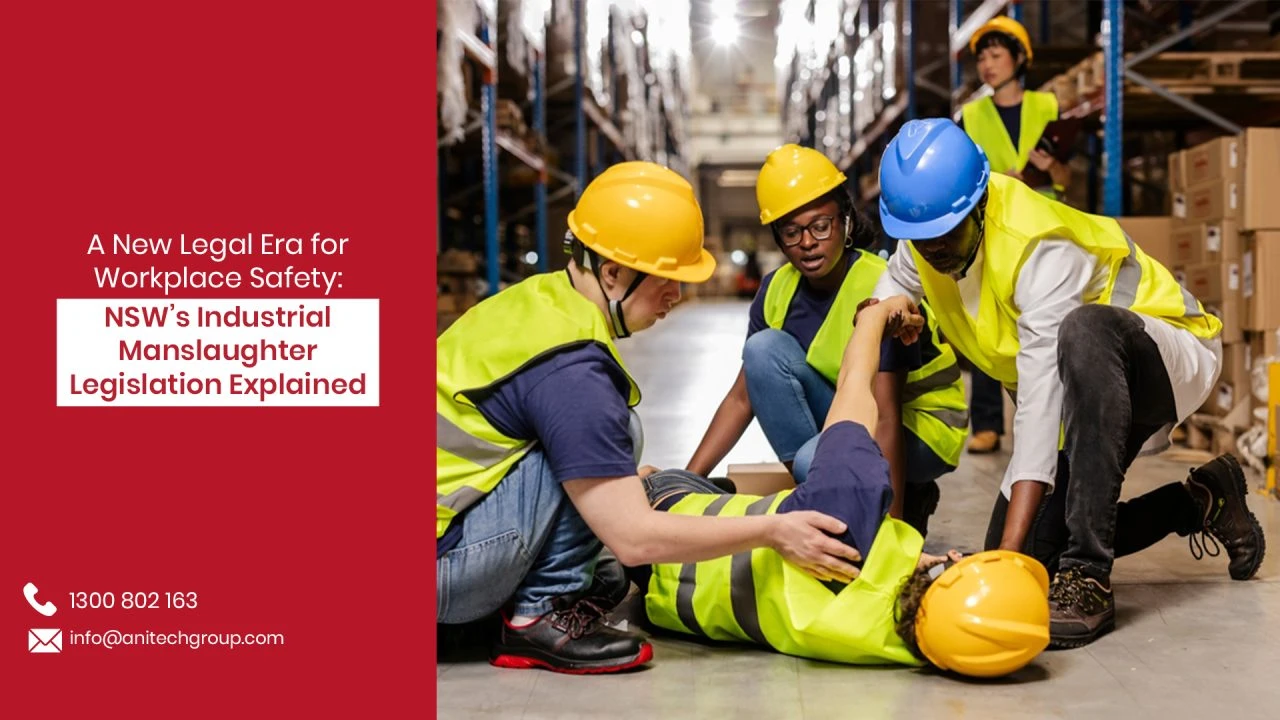
In a major development for workplace safety in New South Wales, the Work Health and Safety Amendment (Industrial Manslaughter) Act 2024 has now made industrial manslaughter a criminal offence under the state’s WHS laws. The legislation commenced on 16 September 2024 and represents a firm step forward to make sure that preventable workplace deaths are treated with the seriousness they deserve.
While this may appear to be a straightforward legal amendment, it serves as a powerful call to action for NSW businesses. It is a call to strengthen workplace procedures, define executive roles, and prioritise safety at the top of the organisational hierarchy. At Anitech, we help organisations adapt to this legislation confidently by helping businesses to take proactive steps.
In this blog, we outline the key changes, why they matter, and what your business should be doing to stay compliant in 2025 and beyond.
What Does the Industrial Manslaughter Law Say?
The NSW Industrial Manslaughter Laws create a new criminal offence under the Work Health and Safety Act 2011. Under this legislation, a person conducting a business or undertaking (PCBU), or an officer of the PCBU, may be found guilty of industrial manslaughter if:
- The person has a health and safety duty.
- They breach that duty.
- The breach is due to gross negligence.
- The breach causes the death of a worker.
This law applies to all workplaces under the WHS Act and covers both individuals and corporations who hold decision-making authority. Importantly, the offence does not apply to volunteers; the focus remains on those with legal and operational control.
The Cost of Non-Compliance
The penalties under the Industrial Manslaughter Legislation NSW are among the most serious in the country for WHS offences:
- Individuals (Officers) up to 25 years imprisonment
- Corporations (PCBUs) up to $20 million in fines
This adds long-term accountability, as businesses cannot assume legal exposure fades with time. These penalties reflect the government’s position that a workplace death caused by gross negligence is a criminal act.
Why the Law Was Introduced
The industrial manslaughter offence was introduced following years of advocacy from affected families, workers, and safety experts. Prior to this legislation, New South Wales lacked a standalone criminal offence for workplace manslaughter, unlike other Australian states such as Queensland and Victoria.
By enacting this law, the NSW Government aimed to:
- Improve the enforceability of serious WHS breaches
- Deter reckless conduct by individuals in leadership positions
- Drive a stronger culture of accountability and prevention in all sectors
Who Needs to Comply?
The law applies to any individual or business with responsibilities under the Work Health and Safety Act 2011, including:
- Directors and officers with decision-making authority
- CEOs, general managers, and WHS leaders
- Corporations operating in high-risk industries (construction, manufacturing, logistics, health, etc.)
If these duty holders fail to act with due care, and that failure leads to a fatality, they can now face criminal charges.
What Should Businesses Do Now?
The introduction of the NSW Industrial Manslaughter Laws has elevated compliance expectations across all industries. While most organisations already aim to provide safe workplaces, this law shifts the risk calculus and makes safety leadership enforceable.
Here are four priority actions:
1. Review WHS Governance
Boards and senior executives must ensure safety oversight is clearly documented and reviewed regularly.
2. Strengthen Risk Management Systems
Reassess hazard identification, incident reporting, and control mechanisms, especially in high-risk areas.
3. Define Legal Duties Clearly
Ensure officers and managers understand their individual WHS obligations under the Act.
4. Embed a Culture of Prevention
Encourage safe work practices at all levels of the organisation, and ensure early warnings are escalated and addressed.
How Anitech Helps Businesses Navigate the Law
At Anitech, we support businesses across New South Wales with tailored safety and compliance solutions that meet the new legal requirements. Our services include:
- WHS framework audits aligned with the new law
- Governance mapping to define accountability
- Executive training on industrial manslaughter obligations
- WHS Policy and procedure updates
- Guidance for strengthening risk management, internal controls and safety culture
- Digital solution – Lahebo – Risk and Compliance Software
We approach compliance not just as a legal necessity but as a strategic investment in your people and your long-term success.
Future-Proofing Your WHS Strategy
The commencement of Industrial Manslaughter NSW legislation represents a serious shift in how workplace deaths are addressed in New South Wales. Gross negligence is no longer a matter of civil penalties alone; it is now a criminal offence, with consequences that extend to the highest levels of leadership.
This reform has been designed to prevent tragedy before it happens by encouraging stronger systems, safer behaviours, and clearer accountability.
At Anitech, we are here to help you take practical steps to align with the law professionally, proactively, and confidently. Contact us to get tailored solutions for your business.


Recent Comments