
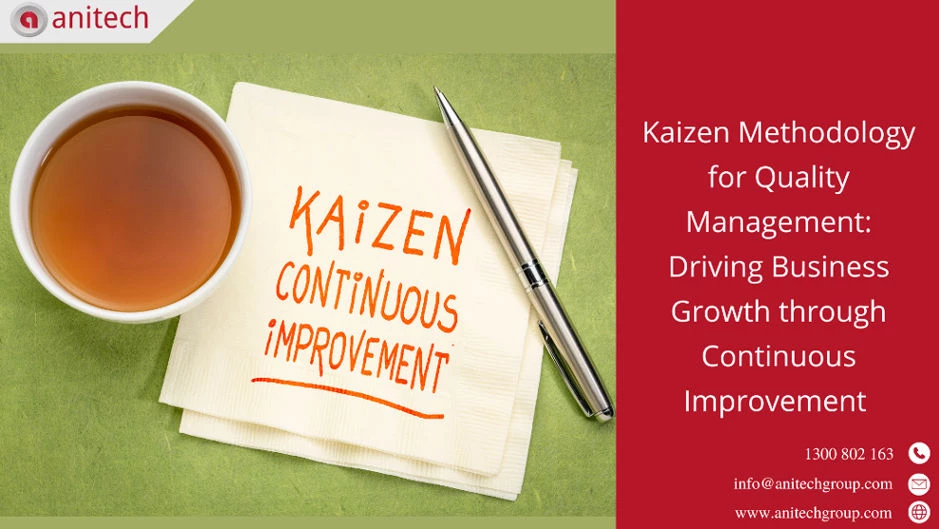
Maintaining a competitive edge is crucial for success in today’s dynamic business environment. Australian businesses are no exception, continually striving to enhance their operations, boost efficiency, and improve product or service quality. One practical approach that has gained popularity is the Kaizen methodology for Quality management.
Originating in Japan, Kaizen emphasises continuous improvement and has been counted as a powerful tool for quality management across various industries.
This blog sheds light on the concept of Kaizen and its benefits and provides valuable tips for its effective implementation to drive business growth in Australia.
Understanding Kaizen Methodology:
Kaizen, derived from the Japanese words “kai” (change) and “zen” (good), is a philosophy centred on continuous improvement in all aspects of an organisation.
Also called as the Kaizen philosophy or Kaizen approach, is a systematic and incremental approach to continuous organisational improvement. Developed in Japan and widely adopted in industries worldwide, Kaizen emphasises the involvement of all employees, from frontline workers to top-level management, in identifying and implementing small, incremental changes to improve processes, products, and services.
Unlike large-scale transformations, Kaizen encourages employees at all levels to identify problems, suggest solutions, and implement changes within their respective domains.
Key Principles of Kaizen Methodology:
1. Continuous Improvement:
Kaizen is based on the belief that every process can be improved. It encourages organisations to constantly seek opportunities for improvement, no matter how small, and implement changes to enhance efficiency, quality, and overall performance.
2. Respect for People:
Kaizen recognises that employees at all levels are the driving force behind improvement efforts. It promotes a culture of respect, trust, and empowerment, where employees are encouraged to contribute ideas and take ownership of the improvement process.
3. Elimination of Waste:
Kaizen identifies and eliminates waste, often called “Muda.” This includes activities that do not add value to the customer, such as unnecessary movement, overproduction, waiting, defects, and excessive inventory.
4. Standardisation and Standard Work:
Kaizen emphasises the importance of establishing standardised processes and work procedures. By defining the best practices and ensuring their adherence, organisations can create a baseline for improvement and continuously refine their standards.
5. PDCA Cycle:
The Plan-Do-Check-Act (PDCA) cycle, also known as the Deming Cycle, is a fundamental component of Kaizen. It involves planning improvements, implementing changes, checking the results, and acting upon the findings further to refine the process in a continuous improvement cycle.
6. Gemba (The Real Place):
Kaizen promotes the concept of Gemba, which refers to the actual location where work is performed. It encourages employees to actively observe, analyse, and address issues directly at the Gemba, fostering a deep understanding of processes and facilitating effective problem-solving.
7. Visual Management:
Kaizen emphasises using visual tools and techniques to communicate information, monitor performance, and make identifying abnormalities or deviations from the standard easier. Visual management enhances communication and supports the continuous improvement process.
Benefits of Kaizen Methodology:
Implementing the Kaizen methodology offers several benefits to organisations, including:
1. Improved Quality:
Kaizen fosters a mindset of quality consciousness. Organisations can eliminate waste, reduce defects, and enhance customer satisfaction by empowering employees to identify and rectify quality issues at the source.
2. Increased Efficiency:
Kaizen helps streamline processes by identifying and eliminating non-value-added activities. This leads to improved productivity, reduced lead times, and enhanced overall efficiency within the organisation.
3. Enhanced Employee Engagement:
Involving employees in the continuous improvement process promotes a sense of ownership and empowerment, encouraging collaboration, innovation, and a shared commitment to achieving organisational goals.
4. Cost Reduction:
By eliminating waste, reducing defects, and improving operational efficiency, Kaizen helps organisations cut costs and increase profitability. It enables them to invest resources wisely and allocate them towards value-adding activities.
5. Adaptability to Change:
Kaizen instils a mindset of adaptability and agility within the organisation. By encouraging regular improvements, businesses become more responsive to market changes, customer needs, and emerging trends.
6. Sustainable Growth:
The continuous improvement mindset fostered by Kaizen enables organisations to adapt to changing market conditions, customer needs, and emerging trends, supporting long-term growth and competitiveness.
Tips for Effective Kaizen Implementation:
1. Develop a Clear Vision:
Clearly articulate the purpose and objectives of implementing Kaizen within the organisation. Ensure that everyone understands and resonates with the vision to drive meaningful change.
2. Foster a Culture of Continuous Improvement:
Encourage open communication, collaboration, and the sharing of ideas. Create platforms for employees to suggest improvements and recognise their contributions. Promote a learning environment that values experimentation and embraces constructive feedback.
3. Provide Training and Support:
Invest in training programs to equip employees with the necessary skills and knowledge to identify improvement opportunities. Encourage participation in workshops, seminars, and Kaizen events to promote a culture of learning and growth.
4. Set Realistic Goals:
Break down improvement initiatives into manageable objectives and define clear metrics to measure progress. Ensure that goals are achievable, measurable, and aligned with the organisation’s strategic priorities.
5. Implement Regular Review Processes:
Establish mechanisms to review and evaluate the effectiveness of Kaizen initiatives. Collect data, analyse outcomes, and make adjustments as needed. Continuous monitoring and feedback loops are crucial for sustaining improvement efforts.
6. Promote Leadership Support:
Leadership commitment and active involvement are vital for successful Kaizen implementation. Leaders should serve as role models, reinforcing the importance of continuous improvement and providing the necessary resources for its realisation.
How can Anitech’s QMS consultants help implement Kaizen for Quality Management for businesses?
QMS (Quality Management System) consultants can play a valuable role in implementing Kaizen for quality management within an organisation. Their expertise and experience in quality management practices can contribute to successfully adopting and integrating the Kaizen methodology. Here’s how QMS consultants can assist in the implementation of Kaizen:
1. Assessing Organisational Readiness:
QMS consultants can conduct an initial assessment to determine the organisation’s readiness for implementing Kaizen. They can evaluate the existing quality management practices, identify gaps, and recommend areas where Kaizen can be effectively applied.
2. Providing Training and Education:
QMS consultants can deliver training sessions and workshops to educate employees about the Kaizen philosophy, principles, and techniques. They can guide identifying improvement opportunities, implementing changes, and sustaining the continuous improvement mindset.
3. Facilitating Kaizen Events:
Consultants can facilitate Kaizen events or workshops within the organisation. These events bring together cross-functional teams to analyse processes, identify improvement opportunities, and develop action plans. Consultants can guide the teams through the Kaizen process, ensuring effective problem-solving and the implementation of feasible solutions.
4. Developing Measurement Systems:
QMS consultants can help establish measurement systems and key performance indicators (KPIs) to track the progress of Kaizen initiatives. They can assist in developing metrics that align with the organisation’s quality objectives, enabling the measurement of improvements and the identification of areas for further enhancement.
5. Providing Guidance on Standardisation:
Consultants can offer guidance on standardising processes and work procedures, which is integral to the Kaizen methodology. They can assist in developing standard operating procedures (SOPs) and visual management tools to support the implementation and sustainability of improvement initiatives.
6. Supporting Change Management:
Implementing Kaizen involves cultural and behavioural changes within an organisation. QMS consultants can provide change management expertise to facilitate the acceptance and adoption of Kaizen practices. They can assist in addressing resistance to change, communicating the benefits of Kaizen, and creating a supportive environment for continuous improvement.
7. Conducting Audits and Reviews:
QMS consultants can conduct audits and reviews to assess the effectiveness of Kaizen implementation. They can evaluate whether the Kaizen initiatives align with the organisation’s quality management system, identify areas for enhancement, and provide recommendations for enhancing the implementation process.
8. Continuous Improvement Support:
Consultants can provide ongoing support to ensure the sustainability of the Kaizen methodology. They can assist in establishing mechanisms for continuous improvements, such as regular review processes, feedback loops, and knowledge-sharing platforms. This helps to embed the Kaizen mindset within the organisation and drive ongoing improvement efforts.
If you want our expert consultants to help you in implementing a robust quality management system based on the Kaizen methodology, feel free to call us at 1300 802 163 or e-mail – info@anitechgroup.com


Recent Comments