
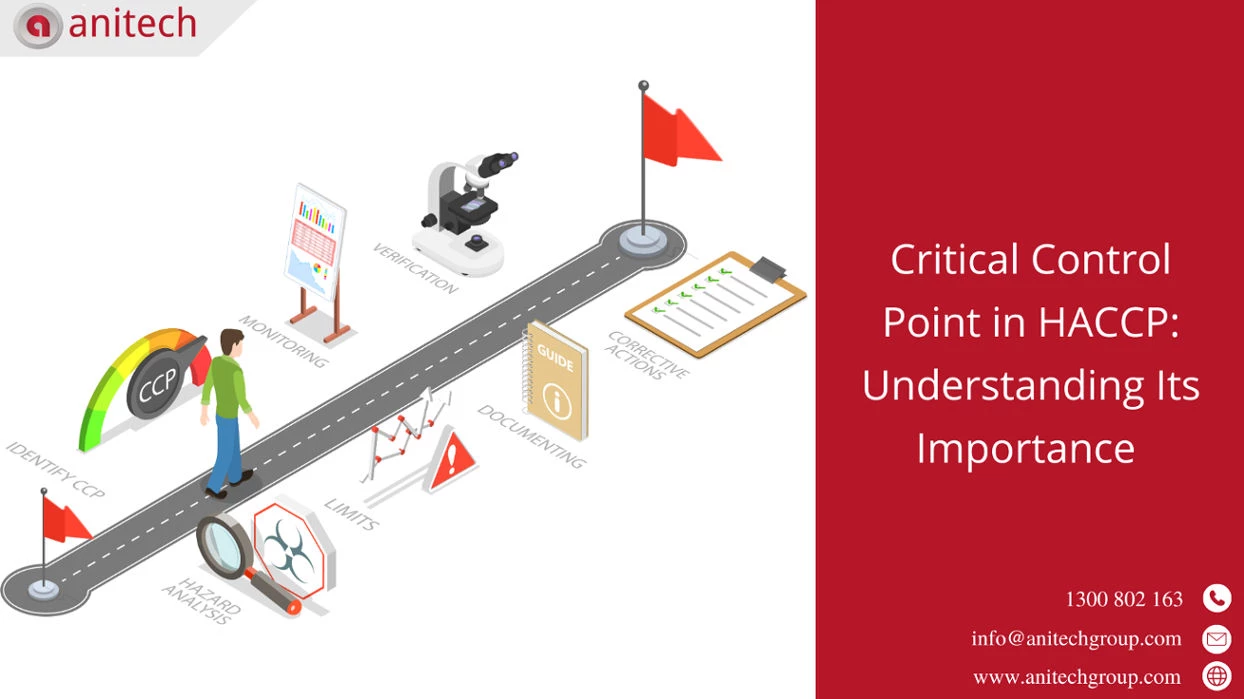
With food allergens and allergies contributing to health risks, it’s crucial for food processing organisations to implement robust food safety measures. One such is the use of a critical control point (CCP) in the (HACCP Hazard Analysis and Critical Control Points) plan of their organisation.
In this blog, we have discussed CCPs, how to identify them and how they can enhance food safety when implemented in a HACCP program.
Critical Control Point (CCP) and its Role in Food Safety
A critical control point (CCP) is a stage in the food manufacturing process when precautions can be taken to stop, lessen, or eliminate a food safety risk, including bacterial growth or chemical contamination. Every step of the process, from acquiring materials through the time the result is eaten, contains critical control points.
CCPs are essential in controlling risks and hazards related to food safety. They serve as barriers against possible pollutants or risks when built and maintained appropriately, ensuring that food items adhere to set safety requirements.
Professionals in the field of food safety like food safety consultants can identify important places where control measures might be implemented by thoroughly reviewing each stage of the production process. These procedures, which attempt to reduce the risks connected with dangers like microbiological growth, chemical contamination, or physical dangers, might include temperature checks, time limitations, pH levels, and more.
How to Identify Critical Control Points with HACCP?
Conducting a hazard analysis and identifying critical control points are time-consuming exercises, but they are necessary to ensure food safety in your business.
Before identifying the critical control points in your food business, it is necessary to list all the potential risks to food safety. These hazards can be classified into three categories: biological, chemical, and physical. Often, these risks can overlap. For example, a strand of hair in your soup can pose both physical and biological threats as it may harbour germs and other microbes.
A HACCP risk assessment plan is a suitable choice to proceed with.
The first and the second principle of the seven principles of HACCP (Hazard Analysis and Critical Control Points), are to be utilised in creating a risk assessment plan to identify critical control points.
HACCP principles form the basis of Food Safety Programs worldwide and can assist you in managing your company’s food safety risks and safeguarding your clients from the fallout of a food safety event.
Some examples of CCPs could be:
- The sign-off stage at the time of receiving deliveries.
- Preparing food at a certain temperature.
- Analysing food temperature before serving it.
When a CCP is required but not present at a stage where a risk to food safety is discovered, the process must be changed to incorporate the control measure.
You may locate CCPs in your organisation (or where they need to be) by using a decision-making tree.
Critical Control Point Decision Trees
A decision tree is one method that may be utilised to discover crucial control points in your food industry. Although CCP decision trees are not a necessary component of a food safety programme, they may be useful to you in visualising and identifying the food safety threats that exist in your company.
Critical control point decision trees are basically flow charts. After making a list of all the steps in your food production process, you can use the CCP decision tree to determine whether or not that step is, in fact, vital for food safety.
It’s crucial to keep in mind that there isn’t a universal template you can use to identify the crucial control points in your company. Every food business is unique, and a variety of circumstances affect both the essential control points that must be employed to manage food safety and the sorts of food safety hazards that are present in the company.
For example:
- Food ingredients and packaging details.
- Suppliers of food and beverage.
- Procedures and policies.
- Preparation surfaces and Equipment used.
- Food safety Training programs
- Food Safety Supervisors in the organisation
- Physical design and layout of the workplace premises.
Establish Critical Limits
A critical limit is the highest or lowest number that must be maintained to avoid, eliminate, or decrease a biological, chemical, or physical danger to an acceptable level. For each danger, each CCP must have one or more critical limits.
Critical limits often relate to variables that can be measured with equipment or have a yes-or-no response, such as:
- Time.
- Temperature.
- Acidity.
- Expiry dates.
Critical limits should be given a precise value, such as the requirement that high-risk meals be prepared to a minimum internal temperature of 75°C*.
However, it can be difficult to determine or assign real numbers to critical limits since there are so many distinct risks, each with a different tolerable range.
Fortunately, data about critical limits may be found in a variety of places, such as:
- Research.
- Technical research papers, reference materials, standard guides, abstracts etc.
- Codes of practice.
Legislation. For example, the Temperature control limits given in the Australia New Zealand Food Standards Code Section 3.2.2.
When making a choice in the absence of facts, always err on the side of caution and keep a record of your justifications as well as any references you consulted for your food safety programme.
As a general guideline, high-risk meals should be cooked until an internal temperature of 75°C, while particular high-risk items may require varying minimum cooking temperatures.
Methods to Monitor Critical Control Points
Food should be monitored to ensure it doesn’t go above the critical limits established for each critical control point (CCP). Simply said, monitoring involves doing something to ensure that food is safe.
Monitoring techniques can be broken down into four different categories:
1) Observation Monitoring – It includes checking cleaning schedules and monitoring delivery checklists.
2) Sensory Monitoring – It uses the sense of taste, touch, and smell to analyse if food is within the required critical limits.
3) Chemical Monitoring – Chemical Monitoring involves checking acidity levels and performing a nutritional analysis.
4) Physical Monitoring – It involves checking food temperature, weight, pressure, etc.
The best way to ensure (and confirm) that monitoring is being done regularly in your establishment is by using checklists and other documentation to record the results.
Establish Corrective Actions
Whenever there is a departure from an acceptable critical limit, corrective actions should be taken. These actions can be either urgent or preventive.
Immediate corrective action stops a current, ongoing breach.
For example:
- Throwing away contaminated food
- Rejecting a food delivery that has a pest infestation.
- Refrigerating food to prevent it from coming into contact with the Temperature Danger Zone (5°C–60°C).
Preventative remedial action aims to stop new breaches from happening.
For example:
- Conduct regular maintenance of equipment and machinery used.
- Introducing changes to the work procedures.
- Training employees to follow best food safety practices.
If remedial or corrective action is required, don’t forget to document it and tell the right person (or persons) in the company.
Once more, a straightforward table may assist you in organising your data in a way that is quick and simple to comprehend. As you move through the process, think about putting up your table at the danger identification phase and adding columns as you go.
Establish Record Keeping Procedures
Keeping records of the hazard analysis and any remedial actions taken is vital for the smooth functioning of your food safety program in your company. This information must be maintained to ensure efficient operations.
AN organisation’s food safety program has several daily records.
For example:
- Delivery checklists.
- Signed-off Cleaning Schedules.
- Temperature recordings.
- Inspection results of pests.
- Training records of the Staff.
Each staff member should be aware of the location of the food safety programme, what they are expected to do (such as updating cleaning schedules and filling out temperature logs), when they must complete it, and to whom they should report problems. During a food safety inspection, health inspectors frequently request this kind of documentation, so be sure you keep it in a secure location.
Establish Verification Procedures
To ensure your food safety program is functioning as intended and to identify areas for improvement, it’s essential to conduct an annual audit. Once you’ve identified these opportunities, make the necessary adjustments and improvements to your programme.
During an audit, food organisations should:
- Conduct internal audits.
- Enlist external auditor’s services.
- Conduct surveys and record employee feedback.
During an audit, the following questions should be asked:
- Have we made any recipe changes or introduced any new goods or dishes?
- Have any procedures or actions involved in food preparation been altered?
- Have there been any modifications to the rules or legislation governing food safety that will influence operations?
- Are there any trends in the data that suggest a chance for improvement?
Businesses that have answered with a ‘yes’ to these questions will have to update their food safety program.
Identifying CCPs will help you to reduce the risk of foodborne illness in your business by helping you to prevent the growth of dangerous bacteria and other microorganisms, as well as to prevent cross-contamination between different types of food, which can trigger life-threatening allergic reactions in some customers.
Ensuring Compliance and Hygiene
1) Meeting Regulatory and Compliance Requirements
-
Role of Critical control points in fulfilling Food Safety Regulations and Standards:
Ensuring food safety is crucial in the food manufacturing process, and critical control points play a vital role in identifying and addressing potential risks. These control points are determined through scientific knowledge and experience, helping companies comply with food safety regulations and standards.
-
Ensuring Compliance with Regulations Imposed by Food Safety Authorities and Organisations:
Businesses may show they are committed to following the rules set out by the authorities and organisations responsible for food safety by putting crucial control points into place. This promotes consumer confidence and public health protection.
2) Sanitation and Hygiene Practices
-
CCP control points for Maintaining Sanitation and Hygiene Practices
Maintaining correct sanitation and hygiene standards in many sectors of food handling, storing, and processing is strongly related to critical control points. These ideas aid in the detection and management of possible sources of contamination, assuring the continued safety of food items.
-
Prevention of Cross-contamination and Assurance of Food Safety:
To ensure that foodborne illnesses are avoided, it is crucial to establish critical control points. By implementing appropriate control measures, businesses can ensure the safety of their food products and protect the health of their customers.
Training and Education for Effective Implementation of CCP with HACCP
The deployment of important control points in HACCP requires appropriate training and instruction. Without a full grasp of these concepts, the system as a whole is susceptible to failure, endangering both customer safety and the quality of the products.
The relevance of essential control points must be understood by all workers involved in food production, and education is a key factor in accomplishing this. These are particular moments in the production process when preventative measures can be put in place to reduce or get rid of potential food safety risks.
Employees acquire the information and abilities necessary to recognise crucial control points and execute the required actions to successfully manage risks through the provision of thorough training. This information reduces the possibility of contamination and guarantees that the product satisfies the necessary safety requirements.
Ensuring All Employees Understand and Adhere to Protocols in Food Production
It is insufficient for a small number of people to be aware of and follow the protocols linked to crucial control points. When there is a lack of communication and understanding among all team members, implementation can frequently be ineffective.
All employees who are involved in food production benefit from training and education programmes that give them a clear awareness of their responsibilities in maintaining key control points. They get knowledge on how to efficiently measure, monitor, and record crucial control points to ensure adherence to defined processes.
Thus, HACCP becomes a team effort where everyone works together to ensure safe and high-quality food products by making sure that each team member is aware of their responsibilities and is equipped with the essential information.
If your business wants to utilise critical control points and develop a robust HACCP plan, our food safety consultants can assist you with their experience and problem-solving skills.
Call us now at 1300 802 163 or e-mail – sales@anitechgroup.com for assistance.


Recent Comments