1300802163
 

Blog

New Psychosocial Laws Are Here: What Your Business Needs to Know

Victoria’s work environments are experiencing a significant transition in a positive way. Traditionally, safety conversations in workplaces predominantly focused on risks and injuries of a physical nature. However, in the new Occupational Health and Safety (Psychological Health) Regulations 2025, mental health is now regarded as equally important as physical safety. Every Victorian workplace should be...

AI and Digital Work Systems: NSW’s First Explicit Workplace Safety Obligations for Algorithms and Automation

The modern workplace is experiencing a significant and rapid shift because of Artificial Intelligence (AI) and automation. These tools can save time and effort, but without proper management, they can also create new kinds of risks. For the first time, Work Health and Safety (WHS) laws in NSW are making this official, guided by a...

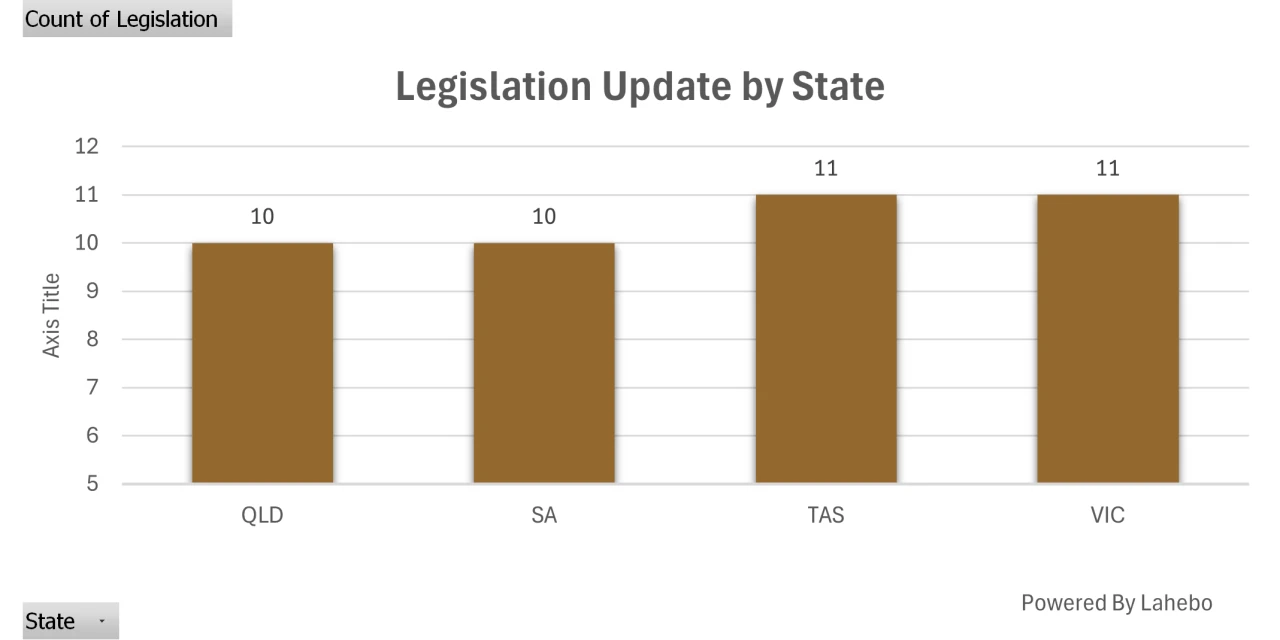
October 2025 Legislative Update: Key Changes Across VIC, QLD, TAS and SA

Australia’s regulatory landscape continues to move quickly, with a wave of new Acts, amendments and regulations landing across Victoria, Queensland, Tasmania and South Australia in 2025. These changes span core areas of public administration and compliance: planning and infrastructure, gaming and gambling harm minimisation, environmental and resource management, tribunal and court procedure, workplace safety and...

Policy Requirements: How Government Procurement’s Green Mandate Will Reshape Supplier Contracts

The rulebook for winning Australian government contracts has been rewritten. While price, quality, and delivery were once the holy trinity, a new, non-negotiable condition has emerged: a verifiable commitment to sustainability. The Environmentally Sustainable Procurement (ESP) Policy is not a suggestion, it’s a new operating model that will reshape how suppliers compete and win work....

The Ultimate Guide to Operational Resilience: How Australian SMEs Can Survive an Uncertain Economy

Running a small or medium-sized business in Australia today feels like navigating a ship through unpredictable seas. There is a constant juggle from supply chain snarls and cyberattacks to shifting interest rates and sudden market changes. These waves of disruption keep coming. It’s no longer a question of if a crisis will hit, but when....

Work Health and Safety Amendment (Standalone Regulator) Act 2025: What You Need to Know

Under the Work Health and Safety Amendment (Standalone Regulator) Act 2025, which started on 1 July 2025, there were substantial changes in New South Wales, where the law underpins how workplace health and safety (WHS) is applied to the whole of government. The act’s primary objective is to establish an independent regulator for work health...

Upcoming Changes to ISO 9001:2026 and ISO 14001:2026 – What Businesses Need to Know

The world of international standards is changing as they adapt to the new challenges and expectations from businesses. Two of the most popular standards, ISO 9001 (Quality Management Systems) and ISO 14001 (Environmental Management Systems), are now in revision. The new versions are expected to be published in 2026, with ISO 14001 expected in early...

Understanding Incident Notification Requirements Under the Model WHS Act

Workplace safety is more than just a legal responsibility, it’s giving people your best effort to protect them, to prevent harm, and to build trust. Under Australia’s Model Work Health and Safety (WHS) Act, workplace incidents defined as “notifiable incidents” must be reported to your relevant regulator without delay.  What is Incident Notification? Under the...

Workplace Exposure Limits 2026: What You Need to Know Before December 2026

Australia is making landmark changes to the chemical safety regulations in the workplace. From 1 December 2026, Workplace Exposure Standards (WES) will be replaced by Workplace Exposure Limits (WEL).  These limits establish the maximum amount of a chemical that a worker can safely exposed to  during the course of their work. The limits only apply...

2025 Mandatory Climate Disclosure: Where Does Your Business Stand?

After Australia’s Securities and Investment Committee, ASIC, adopts climate-related financial reporting in all large-scale enterprises and financial institutions from 1 January 2025, Australia officially enters a new era of corporate responsibility. Even though it’s been six months, many businesses are still having trouble with the practical aspects of climate-related financial reports. While others are already...