
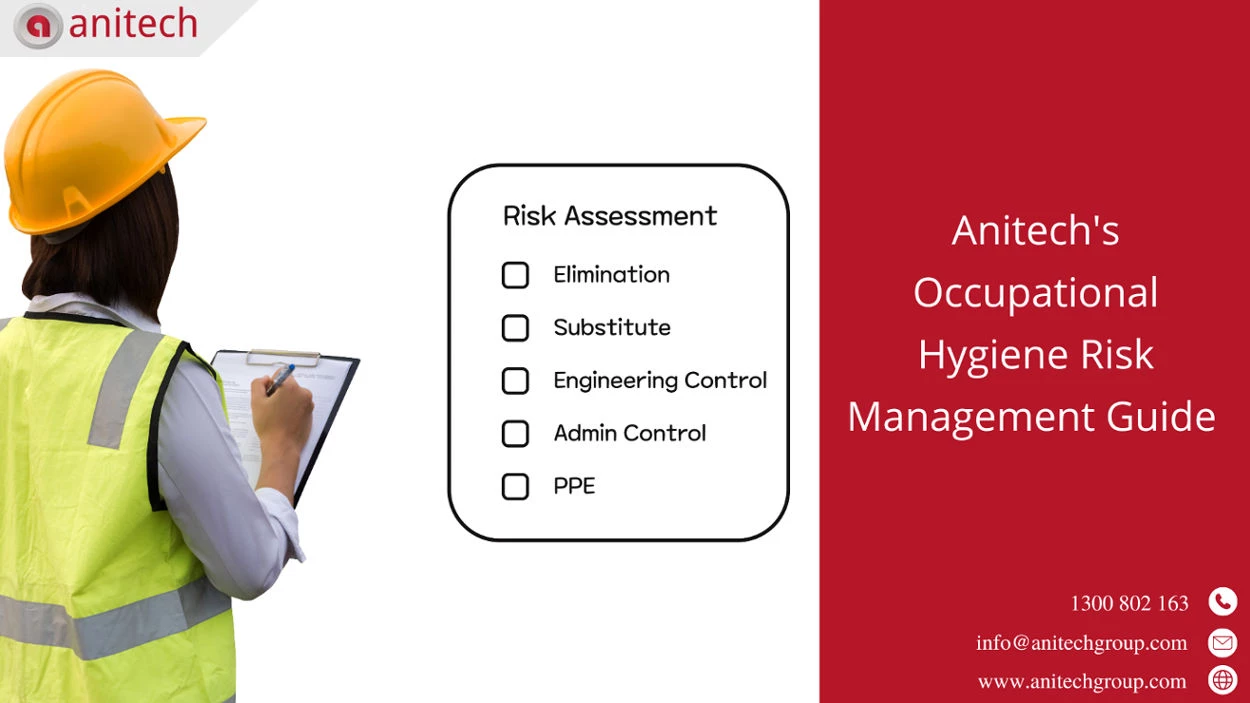
Occupational hygiene risk management is the process of identifying, assessing, and controlling workplace hazards that can affect the health and safety of workers. This can include physical, chemical, biological, and ergonomic hazards. The goal of occupational hygiene risk management is to prevent or minimize exposure to these hazards to protect workers from illness or injury. The process typically involves conducting workplace assessments, implementing controls to reduce exposure to hazards, monitoring the effectiveness of those controls, and making adjustments as necessary. It is an ongoing process that requires regular review and updates to ensure that hazards are being effectively managed and workers are being protected.
Occupational Health and Hygiene Risk Assessments
Occupational Health and Hygiene Risk Assessments involve the analysis of the management systems to find gaps or vulnerabilities.
The foundation of an occupational health risk program is that the potential risk to a person’s health is a result of both the amount and duration of exposure to the hazard, as well as the hazard’s intrinsic ability to cause harm (the health effect or consequence). The ‘probability’ of a health impact is determined by the magnitude and frequency of exposure (or consequence).
A good and adequate occupational health risk management program must include the following components:
- Workplace characterisation
- Hazard identification
- Exposure characterisation
- Risk assessment
- Risk control or treatment
- Monitoring responses and reviewing risks
- Risk register and action plan
1. Workplace Characterisation
The characterisation at a company’s workplace can be done as given below:
- Worker groups that have comparable responsibilities and hence would be anticipated to have similar exposure to the same spectrum of risks, known as ‘Similar Exposure Groups (SEGs),’ might characterise the workplace. SEGs could be based on payroll classifications or personnel employee job (occupation) codes, as well as job observation/interview.
- Location or equipment used, such as looking at the boilermaker’s workshop, electrical trades workshop, spray painting booth, grader operator, and so on; or
- Hazard type, such as noise, hazardous substances, and so on.
The first two techniques are most commonly used, with the first recommended.
2. Hazard identification
Health hazards in each work area or SEG should be recognised and a hazard inventory that covers all the biological, chemical, ergonomic, and physical dangers compiled. The inventory might include any or all of the following:
a) Materials handling/processing
- Ores/process materials
- Process streams
- Wastes and by-products
b) Construction materials
- metals and welding processes/consumables
- insulation,
- refractory
- paints and coatings
- glues
- solvents
c) Maintenance materials
- cleaning agents
- Lubricants
- fuels
- General workplace hazards
- manual handling
- ionising and non-ionising radiation sources,
- noise
- vibration
- biological contaminants
- extreme heat/humidity or cold
- fatigue
- Laboratory chemicals
- Pharmaceutical products
d) Processes to Assist Hazard Identification
The following processes should be considered to assist with hazard identification:
- A review of the inventory of materials/chemicals used and their safety data sheets (SDSs);
- a review of the plant process flow diagrams
- a walk-through survey and discussions with plant personnel, looking at the plant, its processes, equipment, materials use, physical environment, products/by-products, effluents, etc;
- the hours of work e.g., hours of work greater than an 8-hour day, 5-day week (40-hour week) and range of tasks, both routine and occasional in the plant;
- a study of any history of disease or illness from medical records, respecting confidentiality requirements;
- a review of relevant legislation;
- a review of documented specialists or information from similar types of operations;
- a review of any occupational hygiene or health monitoring data, respecting confidentiality requirements;
- a review of the minutes of health and safety meetings;
- the presence of any susceptible individuals such as pregnant or breastfeeding mothers.
3. Likelihood of Exposure characterisation
The chance/frequency of exposure resulting to the specific outcome linked with the hazard under discussion is described by likelihood. It is crucial to evaluate both the exposure to danger and the possibility that damage will occur as a result of that exposure when calculating likelihood. Exposure may be viewed in terms of frequency or time, that is how often or how long one is exposed, and the concentration or the level of the contaminant or agent.
The likelihood is expressed in terms of the following five-point scale:
| Likelihood | Description |
| A – Almost Certain | Almost guaranteed regular encounter at very high levels with the possible threat. |
| B – Likely | Periodic contact with the potential danger at extremely high levels is likely, as is frequent contact with the possible hazard at high levels. |
| C – Possible | Periodic interaction with the potential danger at high levels is possible, as is regular contact with the potential hazard at low levels. |
| D – Unlikely | Unlikely to have periodic contact with the possible danger at moderate levels or regular contact with the potential hazard at low levels. |
| E – Rare | Infrequent, low-level interaction with the possible danger. |
Exposure measurement determines whether employees’ exposure to hazardous substances exceeds the applicable Occupational Exposure Limit (OEL) / Workplace Exposure Standard (WES). It is also used to figure out where and when controls should be implemented. It is occasionally used to find the sort of control required or the efficiency of control. If it is evident that exposure may be decreased with simple measures, or that existing exposure poses a clear danger to health, controls should be installed, and subsequent exposure measurements performed to validate that the controls are successful.
Hazards with extremely limited exposure potential should be reported but not further evaluated.
However, this evaluation must be evaluated on a regular basis to verify that there has not been a deterioration of controls or a change in procedure that has resulted in an increase in exposure.
When analysing the risk of occupational exposure resulting in the consequence or health impact under consideration for a specific agent, the following measures should be taken into account:
Review data for the following:
- Summarised staff health checks (adhere to all confidentiality standards and antidiscrimination regulations);
- personal exposure measurement. Good quality data is essential (see the manual Occupational Hygiene Monitoring and Compliance Strategies);
- Measures taken in the general workplace;
- Specific operations, such as production data, chemical handling, and so forth.
- Consider how these statistics relate to the OEL / WES, period of exposure, individual sensitivity, and so on.
- integrate this with the exposure descriptions to get an exposure probability rating for each SEG, job, location, or task for each relevant hazard. This rating must include current control equipment and processes (e.g., engineering controls, isolation, etc.). However, determining an exposure probability rating for the ‘uncontrolled’ condition may also be valuable.
4. Assessment of Risk Levels
Determining the degree of risk enables the prioritisation of control actions as well as the monitoring and/or assessment of control adequacy.
A risk matrix is used in the risk assessment to evaluate relative (rather than absolute) risk. The axes of the matrix are the consequence and the likelihood.
The conclusion of the risk assessment will indicate the appropriate action, which will be control implementation, information collecting, a mix of the two, or no action. In general, the requirement for additional information will be larger if the information on which the risk assessment was based has a high degree of uncertainty, such as limited exposure data or significant variability of outcomes.
“Active monitoring” may comprise exposure measurement, on-site inspection/observation on a frequent basis, a recording/reporting system, and so on.
There are four possible outcomes for the risk assessment procedure:
- Extreme – requires immediate and urgent control or mitigation, as well as senior executive management attention;
- High – necessitates proactive management to control or mitigate adverse exposures;
- Medium – necessitates active monitoring; and
- Low – is unlikely to necessitate active management beyond existing routine procedures.
This risk assessment procedure should be performed at appropriate intervals, often every 5 years, or if business or process changes.
5. Control of Risks
The risk assessment results are used to establish action identification and control prioritisation. The findings can be included in a risk assessment form for the appropriate SEG, location, equipment, or operation.
a) Hierarchy of Control
Where risk assessment shows the need for controls strategy, their success in reducing or eliminating the risk of adverse health consequences must be evaluated in a phased way according to the hierarchy of controls:
1. Elimination
– Removal of the danger (e.g., process automation). The substance or process should not be used.
2. Substitution:
Substitution or reduction by a less damaging form or method. Find a safer drug or material to use, or a better approach to carry out the procedure.
3. Isolation
– Isolation of the danger from workers (e.g., enclosure with local exhaust ventilation (LEV)). Keep it away from the employees.
4. Engineering Controls
– including process redesign. Create a better method.
5. Procedures and training
– including restructuring work systems and administrative controls such as worker rotation.
6. Personal Protective Equipment
Use of Personal Protective Equipment (PPE) in the workplace (the last line of defence)
7. Specific controls requirement
Carcinogenic, mutagenic, and reprotoxic (CMR) agents frequently have specific control needs, such as limiting their usage by replacing them with agents and procedures that offer less or no risk. Collective controls including physical enclosure, Local exhaust ventilation(LEV), and mechanisation of certain operations should be prioritised above the usage of PPE (e.g., gloves, gowns, overalls, boots, and face shields). PPE should only be used in cases where all other measures are either not applicable or ineffective enough.
Whenever possible, purchase criteria should be devised such that new equipment brought to the site eliminates or reduces exposure and, at the very least, does not expose employees to more than the OEL in operational mode.
Control systems should be as follows:
- Designed to be consistent with process and maintenance needs;
- Designed in accordance with appropriate occupational hygiene engineering standards;
- Cost-effective in controlling potentially hazardous exposures; and
- Regularly maintained and monitored for efficacy.
b) In case of Exposure to Poisonous/ Substances
When risk assessment reveals that exposure to poisonous or radioactive chemicals must be reduced, excellent personal hygiene must be enforced.
- No smoking, eating, or drinking in designated hazard areas;
- Hand and face washing prior to eating or smoking;
- Showering at work post shift or after exposure to ‘dirty’ conditions;
- Laundering of contaminated clothing by the PCBU; and
- Clean shaven personnel where respiratory protective equipment requiring a face seal is used, as well as formal fit testing of the respirator.
c) For PPE
PPE should only be used to accomplish OEL compliance when the adoption of higher-level controls is not proportionate to the amount of risk and expense, when higher-level control solutions are being developed and implemented, or for short-term jobs. Where PPE is necessary, it must be available, suitable, and well-managed such that:
- A single person or function should be allocated overall responsibility for the site’s PPE program.
- The program must be adequately documented, including contractors;
- The program must specify the selection, administration, maintenance, and replacement of PPE, training, and designate responsibilities, as well as include signposting for PPE use;
- The programme must be consistent with local standards or regulations; PPE that is defective or damaged must be replaced.
- Protective equipment requirements must be indicated in operating manuals, and procedures must be posted in hazardous areas and included in employee training;
- Employees must be trained in the health effects of specific hazards, when to use which PPE, how to fit it correctly, how to identify when it is no longer effective, what to do if it fails, and how to maintain it; and
- PPE use must be assessed on a regular basis to ensure its continuing relevance.
6) Monitoring responses and reviewing risks
Controls frequently fail due to improper maintenance after wear and tear or because the process changes without a corresponding change in the controls. It is critical to ensure that exposure risk is reviewed on a continuous basis, rather than simply when the control is introduced. For each exposure category, the risk assessment should reach one or more of the following findings.
- The risk is managed by engineering and process controls.
- The danger is reduced by using PPE, procedures, and training.
- There is insufficient evidence to make a valid judgement;
- Substitution or the isolation of engineering controls must be considered, and any reasons for not adopting them must be documented.
- There is a health risk at present exposures. This must be accompanied by a declaration on the time period during which meaningful data will be obtained. This must be accompanied by an action plan and timetable for mitigating the identified risks.
7) Risk register and action plan
The risk management strategy should result in a complete Risk Register that covers all the significant hazards to worker health.
For each recognised risk, the Risk Register should include the following information:
- A unique reference number;
- The date of the risk assessment;
- The date of the review;
- A description of the risk – what can happen and how, if applicable;
- An explanation of current controls;
- The consequence and likelihood of the consequence given the controls in place;
- The risk level;
- The overall priority of the risk;
- The status of any further controls necessary; and
- The responsible officer
The risk register should be utilised to create a management action plan with clear accountability. To achieve ongoing improvement, senior management should examine the risk management process.
The process of occupational health risk management should result in the prioritisation of potential health risks to facilitate the development of:
- An action plan to cost-effectively eliminate or reduce adverse exposures; and
- Occupational hygiene and medical surveillance monitoring programmes, as needed.
Health and Hygiene Management Plans (HHMP)
Occupational Hygiene Risk Assessments are also called Health and Hygiene Management Plans.
Workplaces must conduct a structured health and hygiene risk assessment of their occupational health hazards and create risk-based management plans to record and maintain operational risks (whether implicit or explicit).
- This requirement is backed by documentation from a variety of states and industries, including, but not limited to:
- The WA Department of Mines, Industry Regulation and Safety uses the – Health and Hygiene Management Plan/(HHMP)
- The International Petroleum Industry Environmental Conservation Association uses – A Roadmap to Health Risk Assessment in the Oil and Gas Industry; and
These risk assessments typically necessitate an annual review to determine currently underway risk and control.
Occ Hygiene consultants can help you design efficient risk-based management plans. They will also assist in its implementation and compliance and help your organisation in achieving certification from the governing body.
HSE Management Plans
Health, safety, and environmental management plans are created to provide all employees, contractors, and visitors with a transparent, holistic view to help them minimise health and safety risks on the job site.
Individuals will be able to perform their work in a risk-free, safe and healthy manner as they will be capable of recognising and controlling hazards that might be witnessed in their everyday tasks.
Anitech’s Occupational Hygiene Consultants can ensure Australian businesses that all management practices implemented on-site are in compliance with the applicable regulations and laws.
Risk Workshop Facilitations - HSE risk assessment workshops help identify the various HSE risk related to the operations in the discussion. Risk workshops can be conducted at any operational phase, such as design, operation, and or maintenance stage. Workshops can also be held prior to the commencement of any construction work; the only criterion obligation is for experienced main operators who are well-versed in the anticipated processes.
Based on the activities identified during the workshop, Anitech’s occupational hygiene team can help your Company create an HSE risk register with the help of our newly launched Risk and Compliance Management software – Lahebo.
Infectious Disease Management Plan
All mining activities should create and reassess, as needed, an “infectious diseases management plan” specific to the site’s location, facilities, and resources. The strategy should comprise of, but should not be limited to:
- risk management process;
- roles and responsibilities;
- employee training and education;
- controls;
- protocols for isolation – Individuals in isolation must follow protocols for room cleaning and meal delivery;
- handling ill employees;
- a strict policy governing the use and disposal of contaminated equipment, especially masks, and gloves;
- cleaning and disinfection routines;
- mental health support
- program review
How can Anitech help?
Anitech’s Occupational Hygiene consultants can help you design efficient risk-based management plans for businesses and create their Risk Registers with the help of our real-time platform – Lahebo. They will also ensure that these Risk Registers are up to date and that the mitigation processes comply with the regulation.
Anitech’s Occupational hygiene team is experienced in helping clients create and implement bespoke processes to secure their workplace.
To learn more about our services and how we can help you in creating a risk management plan and Risk Register, feel free to call us at 1300 802 163 or email info@anitechgroup.com
We will be happy to help you!


Recent Comments