
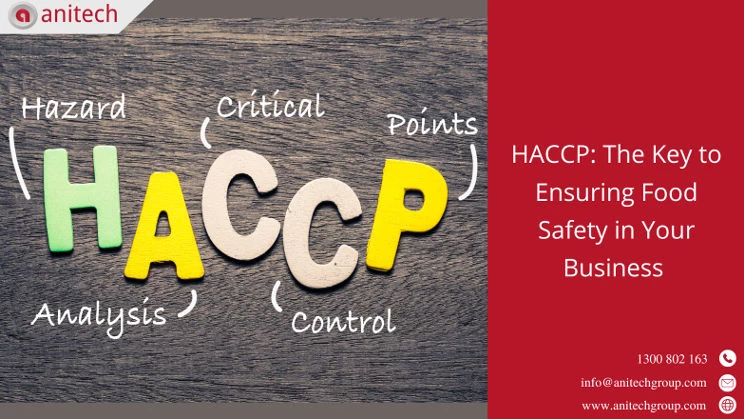
Having a food safety program based on the seven principles of HACCP is legally required for most food Companies in Australia.
In this blog, we discuss why the HACCP program is the key to ensuring food safety in businesses.
HACCP – Definition, Origin and Primary Focus
Hazard Analysis Critical Control Points, or HACCP, is an approach to food safety and risk assessment that was first created by NASA and a group of experts in food safety in the 1960s.
HACCP’s primary focus was not initially on terrestrial food production, but rather on a much loftier challenge, which was ensuring the well-being of astronauts during space missions.
To guarantee that food for space missions was safe, NASA, Pillsbury Company, and U.S. Army Laboratories created the HACCP system in the 1960s. NASA and Pillsbury used the Critical Control Points (CCP) guideline to verify the dependability of engineering and weapon systems, removing significant failure points from food manufacturing processes.
These two teams collaborated to find a solution to two pressing issues affecting NASA’s crewed space missions: crumbs and pathogenic germs, viruses, or poisons.
However, Howard Baumann, a microbiologist with Pillsbury, promoted HACCP following a recall of Farina cereal due to glass fragments and residues. Following an examination of HACCP and GMPs at the National Conference on Food Protection in 1971, the FDA asked Pillsbury to set up a training program for can food inspection. HACCP was utilised for the first time to instruct other food factories in the sector.
The foundation of today’s acknowledged global food safety programs is based on HACCP concepts. HACCP concepts are used to manage food safety in a variety of food Companies and may be applied to operations at every level of the food supply chain, including manufacturing, preparation, packing, and distribution. Their implementation can help in enhancing the business process of food businesses.
Seven Principles of HACCP
The seven principles outlined by HACCP are essential for guaranteeing the safety of food.
They are as follows:
1. Conduct a Hazard Analysis
One of the crucial initial stages in the food industry is identifying potential risks that may arise.
2. Identify Critical Control Points
A Critical Control Point (CCP) is a location where risks can be minimised, eliminated, or averted during the production of food.
3. Establish Critical Limits
A critical limit is the highest or lowest value at which a biological, chemical, or physical risk to food safety must be under control. Government regulators frequently establish essential limit standards.
4. Monitor Critical Control Points
To ensure that dangers don’t exceed the established critical limits, monitoring each CCP is crucial. Observation, sensory, chemical, and physical monitoring may all be divided into these four groups.
5. Establish Corrective Actions
Corrective action should be taken whenever a risk surpasses its critical limit. Corrective measures might be urgent or proactive.
6. Establish Record Keeping
Any danger witnessed should be documented completely and regularly, including any remedial measures. A food safety plan, which is a live document and a component of a food safety programme, is where these documents are maintained together.
7. Establish Verification Procedures
Verification processes can assist in figuring out whether your HACCP food safety programme genuinely prevents the identified threats. To make sure everything is running well, it’s crucial to audit your food safety programme at least once each year.
Food Safety Plan
A Food Safety Plan is a crucial component of every food company’s Food Safety program. This contains concrete proof that all procedures and actions involved in food preparation have been listed.
An Environmental Health Officer (EHO) will examine your Food Safety Program and its records while conducting an audit of your food industry.
Standard 3.2.1 of the Food Standards Code (‘the Code’) permits: ‘States and Territories can compel food companies to develop a food safety program based on the HACCP ideas. The food company is responsible for implementing and reviewing the food safety programme, and it is subject to recurring audits by a competent food safety auditor.’
Protect Brand and Customers
Food safety is becoming more and more crucial as reports of food illness make headlines and horror stories of food contamination, allergen infection and food poisoning etc., flood social media.
Therefore, businesses need a HACCP food safety program, obligated by law, to shield their company from being responsible for an outbreak of a food-borne illness or triggering life-threatening allergic responses to food allergens.
HACCP program is therefore the need of the hour for Food processing industries for improving the quality of their products. This in turn will enhance the trust of consumers eating them.
Benefits of HACCP For Your Business
Now that we have a better understanding of what HACCP is and how it helps to protect businesses and consumers, let’s dive deeper into the wider benefits that HACCP can offer you as a business owner.
1) Meet Your Legal Obligations
It is mandatory for all food businesses operating in Australia to adhere to the Australia New Zealand Food Standards Code, which is a bi-national standard that has been incorporated into the food regulations of all Australian states and territories as well as New Zealand.
Furthermore, all food organisations should adhere to the Food Act of 1984 and Food Regulations.
Businesses also have to adhere to the Kilojoule Food Labelling Scheme introduced by the Victorian Government.
Businesses would require implementing a robust management system along with a HACCP plan to comply with all the legal requirements, laws and regulations in Australia.
2) Protect Company’s Bottom Line
Businesses that violate food safety and hygiene laws are subject to substantial fines. In addition to the prospect of legal action, the government can levy hefty penalties and pursue firms for money.
Legal action taken by customers could result in costly court fees and settlements, not to mention potential negative customer reactions that could have a detrimental impact on your brand’s reputation.
HACCP enables organisations in preventing these expensive occurrences in order to protect their company’s bottom line and achieve profitability.
3) Win New Customers
Reputation is crucial for a food safety organisation. An organisation’s reputation will become stronger as they provide consumers with a pleasant and hygienic dining experience.
HACCP can enable you to have a laser-like focus on food quality. It will ensure that you provide excellent meals and have a solid reputation that draws in more consumers.
4) Ehance Quality of Food Products
Effective food safety management systems help food businesses prioritize quality and safety. By directing attention to the right areas, these systems allow for an unwavering focus on producing high-quality food items. As a result, the overall quality of the food is improved.
5) Promote Team Efficiency
Almost all businesses spend a significant amount of money on manual labour, thus it’s critical that your labour investments return on your investment be higher. To maximise productivity and provide the outcomes you want, your team must operate successfully.
Downtime is decreased by HACCP. It offers the frameworks and pushes that maintain your crew working nonstop to grow your company.
6) Provide Evidence of Due Diligence
Customers can mistakenly think that your organisation’s food product was to blame if they become unwell after eating your meal. This can land your Company in the soup.
However, HACCP can provide you with the ability to demonstrate the security of your goods. HACCP creates a tonne of precise and sophisticated data that you may use to demonstrate that you have exercised due diligence. This information might make or break your legal defence and help in keeping your company alive.
7) Boost Employee Morale
Every worker wants to believe that they are employed by a reputable company that makes a difference in the world. People in the food sector are especially enthusiastic about giving customers a wonderful dining experience.
HACCP is a sign of how seriously your company takes matters of food safety and cleanliness. HACCP compliance may excite and encourage your staff, which can raise morale.
HACCP Certification
In order to obtain HACCP accreditation, a business needs to perform a hazard analysis, identify critical control points, and put measures in place to manage those hazards. This process must be confirmed by a certified HACCP auditor.
Choosing a trustworthy certification provider is vital for food businesses seeking HACCP certification to meet external regulatory standards.
A thorough audit or assessment is necessary, and the expense and duration of this procedure will vary depending on factors such as the size of the company and the items they manufacture.
Hence, choosing a suitable Food Safety Consultant like the ones from Anitech is essential for Food Companies to ensure they do not miss any important steps.
Role of Expert Consultants like Anitech Consultants in Implementing HACCP
Anitech, a reputable brand in the field of food safety consultancy, is familiar with the intricate network of rules, best practices, and changing market trends. Working with such knowledgeable consultants has a number of advantages that are essential for a company’s success:
1. Comprehensive Understanding:
Anitech’s expert consultants have a thorough understanding of HACCP concepts, legal regulations, and industry norms. Their knowledge can aid organisations in understanding the challenges involved in creating a customised HACCP plan that is appropriate for their operations.
2. Customised Approach:
The activities of every company are distinctive. Anitech and other experts in the field are aware of this and work closely with companies to create a HACCP plan that takes into account their unique processes, food products, and difficulties.
3. Risk Identification and Mitigation:
Anitech’s Consultants are skilled at seeing possible risks and crucial control points that company employees might not notice right away. Businesses may proactively address risks and stop problems with food safety thanks to this detailed research.
4. Efficiency in Implementation:
It takes careful documentation, process analysis, and staff education to create a HACCP plan. This procedure is streamlined by consultants, who also ensure successful execution while requiring less time and money.
5. Expertise in Training:
It is crucial to educate employees on correct food safety procedures. To ensure that workers at all levels are knowledgeable in upholding food safety standards, our expert consultants offer training programs suited to the business’s needs.
Advantages of Seeking Professional Help
Collaborating with expert consultants like Anitech offers a lot of advantages that extend beyond the technicalities of a HACCP plan:
1. Certification Success:
Obtaining HACCP certification is more than just a badge; it’s a sign of a company’s dedication to protecting the safety of its goods. Consultants assist companies in meeting all requirements for certification and guiding them through the certification process.
2. Risk Mitigation:
Businesses may lessen the possibility of recalls, legal proceedings, and reputational harm by proactively identifying and resolving possible dangers. Risks are reduced, which results in considerable long-term cost savings.
3. Consumer Trust:
Consumer confidence is increased by demonstrating a commitment to food safety through certification and professional advice. This trust translates into brand loyalty and favourable word-of-mouth in an era where customers are more concerned about the origins and safety of their food.
4. Regulatory Compliance:
Food safety laws are always changing. Our expert consultants help businesses stay compliant and prevent fines and operational delays by staying up to date on these developments.
5. Continuous Improvement:
Continuous improvement is emphasised by Anitech and other experts. Following implementation, they offer continuous assistance, evaluations, and modifications to make sure the HACCP plan continues to function as intended as the company grows.
With Anitech’s HACCP Food Safety Plan, you can safeguard your clients and your organisation from a food safety event and ensure that your food safety program outlines the HACCP principles.
To get advice on how to prepare a HACCP Food Safety plan, call us now at 1300 802 163 or e-mail – sales@anitechgroup.com
Our expert consultants will be glad to help you with our exceptional service and shall educate your staff with their experience. We can also assist your business in getting certification.


Recent Comments