
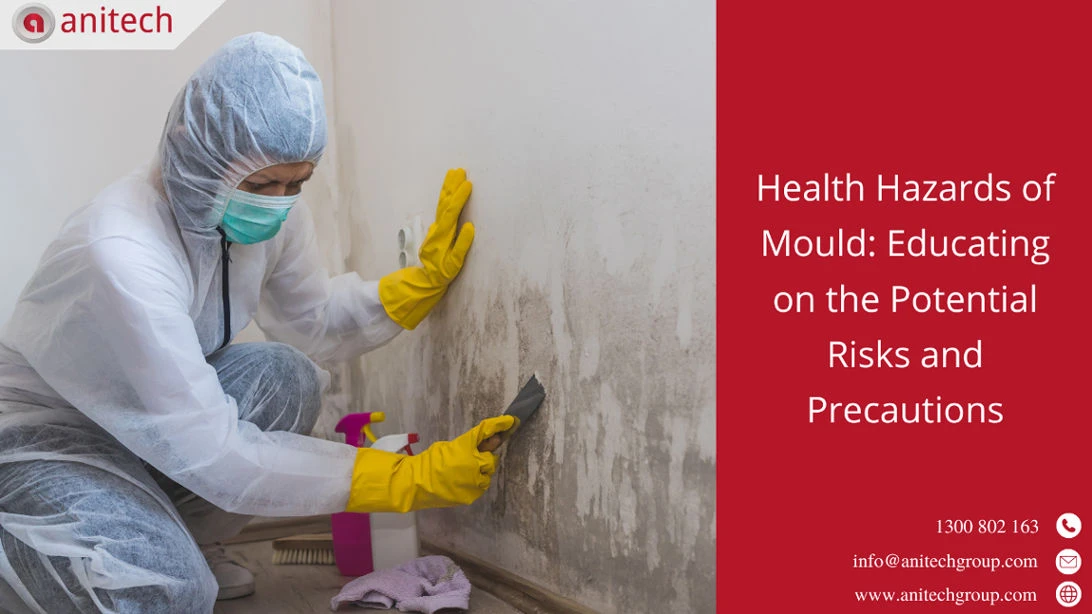
In Australia, where humid climates and periodic flooding can create ideal conditions for mould proliferation, grasping the health risks associated with mould and taking essential precautions assumes paramount importance. Mould, often regarded as a routine workplace issue, frequently goes underestimated in terms of its impact on health. It transcends being a mere visual nuisance, carrying the potential for severe repercussions on both personal and familial well-being. It can worsen preexisting respiratory conditions and even serve as a catalyst for the emergence of new health challenges.
In this article, we will discuss the importance of understanding mould health risks and why it’s essential to take action to prevent its growth in your workplace.
Mould
Mould is a type of fungus that grows in damp and humid areas, such as bathrooms, kitchens, and basements. It thrives in areas with poor ventilation and can spread quickly if not treated.
Mycotoxins, primarily produced by black mould, can be released into the air. Their concentration increases as mould multiplies. While low concentrations may not be harmful, those more susceptible, like the elderly, young, or individuals with respiratory conditions, may experience adverse effects as levels rise. Prolonged mould exposure can cause severe symptoms, even in those initially unaffected.
Common Mould Types Found in Indoor Environments
Cladosporium, Aspergillus, Penicillium, and Stachybotrys are typical indoor moulds that are comparable to those found outdoors. Cladosporium, a black or green mould, has been linked to respiratory problems and allergies. Aspergillus, a prevalent damp-area mould, can cause respiratory infections and allergic responses. Penicillium, a kind of green or blue mould, can cause respiratory problems as well as allergic responses. The black mould Stachybotrys can cause respiratory and neurological issues. Mould exposure can be hazardous.
Health Effects of Exposure to Mould
As mould grows inside your workplace or home, it releases spores that can trigger various health problems, especially in people with allergies, asthma, or weakened immune systems.
Toxicological studies probe the potential of microbial agents in damp buildings to trigger toxicological mechanisms, shedding light on the various biological processes underlying health concerns related to dampness and mould exposure.
Both atopic and nonatopic individuals appear vulnerable to adverse health effects from such exposure, although some outcomes are more prevalent in atopic individuals. The precise mechanisms through which non-infectious microbial exposures contribute to these health effects in indoor environments remain largely uncharted territory.
Here are some common symptoms and health risks associated with mould exposure:
Common Symptoms of Exposure
The symptoms of mould exposure can vary from person to person, but some common signs include:
- Coughing and sneezing
- Nasal congestion
- Wheezing or shortness of breath.
- Throat irritation and soreness.
- Headaches.
- Fatigue.
Health Risks Associated with Mould
Mould exposure can lead to severe health complications among workers, particularly in high-risk individuals. Some potential health risks of mould exposure include:
- Hypersensitivity pneumonitis, asthma, asthma or chronic obstructive pulmonary disease (COPD), chronic bronchitis, and other respiratory disorders
- Fungal infections in the lungs, skin, and other organs
- Nervous system damage
- Memory loss and cognitive impairments
- Chronic fatigue syndrome
- Cardiovascular problems
- Cancer (in rare cases)
- Allergic reactions.
- Other allergic symptoms like itching, redness, eye irritation and watery eyes.
Long-term Exposure to Mould – Symptoms and Health Hazards
Regardless of your present health, prolonged exposure to mould in the workplace or home can be dangerous.
For those who are susceptible, even a small exposure might result in a variety of symptoms.
The condition known as mycotoxicosis, or mould poisoning, can worsen existing respiratory conditions. While it’s important to remember that not just sensitive people experience these sorts of symptoms, those who have asthma may see an increase in symptoms like wheezing and attacks.
Long-lasting coughing, wheezing, and breathing difficulties have been observed in perfectly healthy people without a history of respiratory problems. In addition, prolonged mould exposure can weaken the immune system, which might result in even severe illnesses like bronchitis.
Long-term exposure can make it difficult for sufferers to recuperate while also causing them to get these illnesses, creating a vicious cycle of discomfort.
Other symptoms besides respiratory problems include eye irritation, skin discomfort, and sinus problems.
People who have been exposed to mould over an extended period of time may start to exhibit symptoms including frequent headaches and migraines, increased tiredness, and sporadic muscular cramps as the toxicity grows.
In more extreme situations, the exposed individual may also experience light sensitivity, unexpected weight gain, and hair loss.
If a worker begins exhibiting any of the physical symptoms that might result from prolonged exposure to mould, without warning, it may be essential to conduct a workplace enquiry.
Mental Health Issues Caused by Prolonged Exposure to Mould
While the physical effects of prolonged mould exposure have been extensively studied and well recorded, more recent research has focused on the relationship between prolonged mould exposure and a few psychological problems. Your mental health will be affected by exhaustion, sensitivity to light, unexpected weight gain, and hair loss, but long-term mould exposure has been linked to other symptoms as well. In certain situations, people have complained of disorientation, difficulties focusing, worry, sadness, and appetite loss. If the individual who is being exposed has already experienced brain damage of some kind, these problems may get worse.
Even though there is still much to learn and comprehend about how mould poisoning can result in these problems, it is crucial to realise exactly how serious untreated mould can be.
Risk Factors and Susceptibility to Mould-related Health Complications
While exposure to mould can affect anyone, certain factors may increase the risk of developing health complications related to mould exposure.
Existing respiratory conditions, such as asthma or allergies
- Weak or compromised immune system.
- Age (the elderly and young children are more susceptible to mould-related health problems)
- Prolonged exposure to mould
- Exposure to high levels of mould
To reduce the risk of developing mould-related health problems, it is crucial to take steps to prevent and control mould growth in indoor environments.
Water Damage and Mould Growth
High air humidity, condensation, and water damage promote the survival and growth of dust mites and fungi, resulting in increased exposure to mite and fungal allergens and fungal toxins and irritants.
Water damage can occur due to various reasons such as flooding, leakage, or condensation. When this happens, the excess moisture can create a perfect breeding ground for mould to grow and thrive. In addition, water damage can weaken the structural integrity of a building and cause further damage if left unattended.
Moisture Control to Prevent Mould
Prevention is key to preventing mould growth. By managing moisture levels and addressing any leaks or water damage immediately, you can mitigate the risk of mould growth and related health complications.
Mould Assessment or Audit
Mould growth models prove valuable in assisting field investigations through spore concentration measurements of material samples. A comprehensive inspection, coupled with necessary measurements, serves to validate indoor moisture levels and microbial growth. It’s important to note that mould fungi typically require a relative humidity of at least 80% (Adan, 1994) or at least 75% within a temperature range of 5–40 °C (Viitanen, Ritschkoff, 1991) to thrive. Hence, maintaining workplace humidity levels above 75% is advised.
However, for susceptible surfaces, keeping relative humidity below 75–80% based on experiments with common building materials can effectively prevent fungal growth. While predicted mould growth aligns reasonably well with measured spore concentrations (Pasanen et al., 2001), these correlations may have application-specific limitations. For a more precise assessment, the bio hygrothermal model (Sedlbauer, 2001) factors in moisture transfer at the spore level, accounting for transient microclimatic conditions during interim drying of fungal spores.
Another widely used model, the isopleth model and its extension, the transient bio hygrothermal model, is applicable to various materials. In most cases, a mould growth index of 1 (detectable under a microscope) serves as a relevant design criterion.
Precautions to be taken
Effective moisture management necessitates precise control of temperature and ventilation to prevent issues like excess humidity, surface condensation, and moisture buildup in materials.
Business owners bear the responsibility of furnishing a healthy workplace environment devoid of excessive moisture and mould through meticulous building construction and maintenance.
Workers or occupants play a crucial role by managing water usage, heating, ventilation, and appliances judiciously to mitigate the risk of dampness and mould growth, contributing to a healthier indoor environment.
- Ensure proper ventilation in kitchens and bathrooms.
- Regularly inspect and maintain plumbing and HVAC systems.
- Monitor humidity levels in indoor environments at your workplace.
- Address leaks and water damage promptly
- Install dehumidifiers and air purifiers as needed.
- Seek help from occupational hygienists to enhance air quality and implement controls to prevent mould growth.
- Promoting awareness among employees about the possible health risks linked to mould exposure can aid in averting detrimental health consequences.
Control Measures
While the underlying causes of mould and mites are universal, the strategies to manage them may vary. Indoor relative can be readily controlled by ventilation or air conditioning.
The primary approach for control revolves around moisture management. Effective moisture control encompasses the regulation of liquid water, indoor humidity levels, and condensation, alongside the selection of materials and hygrothermal assembly designs that inhibit mould growth and moisture-related issues.
When it comes to air-conditioning systems, their design and operation should actively prevent microbial growth.
However, caution must be exercised when adding humidifiers to ventilation systems or using standalone units, as they can introduce excess humidity, chemicals, or microorganisms that thrive in humid environments.
Methods should be further developed to allow the calculation of fungal spore transport through building assemblies.
An expert consultant can examine the quality of air at your workplace by performing air and providing controls to enhance air quality and prevent mould.
Anitech’s experienced consultants can assist you in controlling mould formation at your workplaces. Call us today at 300 802 163 or e-mail – sales@anitechgroup.com, and our team will be happy to help!


Recent Comments