
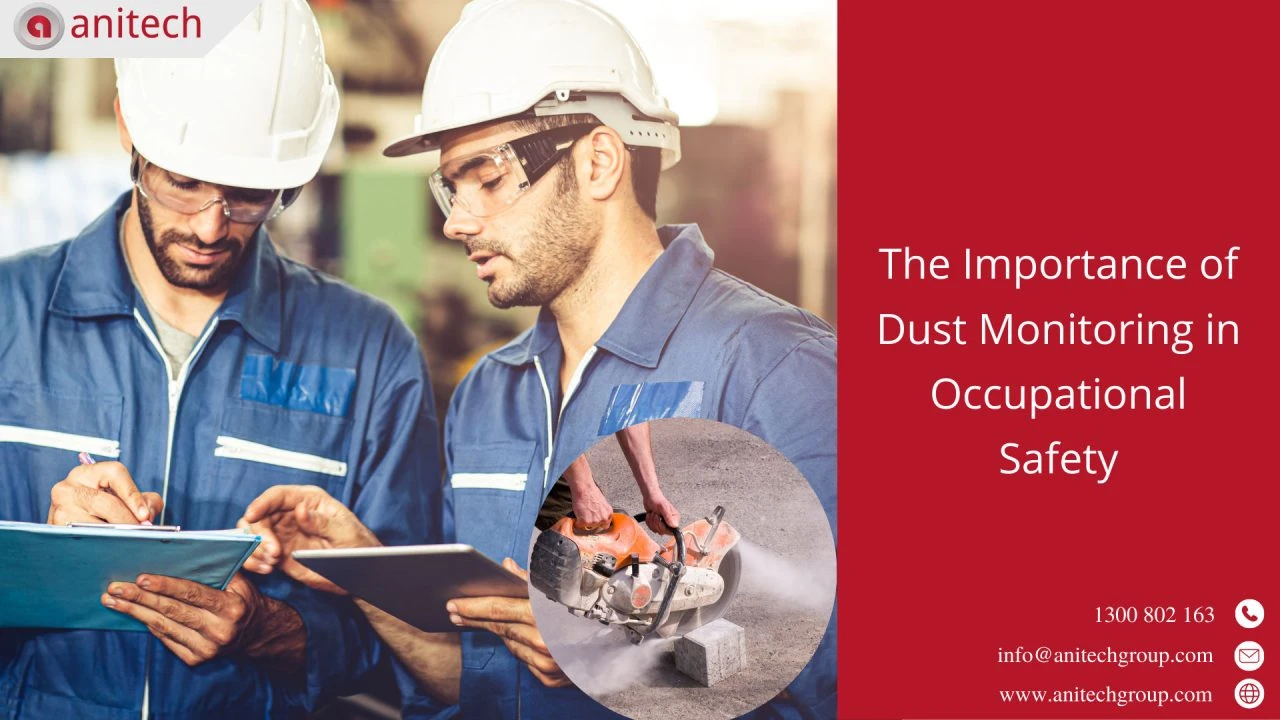
Industrial workers are at the highest risk of exposure to workplace dust which can compromise their health and lead to short-term or long-term diseases. Hence, dust monitoring plays a key role in curbing the various industrial hazards caused by exposure to harmful dust including silica dust, asbestos, coal dust etc.
In this blog, we will explore the often-overlooked importance of dust monitoring, uncovering its potential health and environmental risks, and diving into the essential objectives of a dust monitoring program.
Dust Monitoring
Industrial dust monitoring in Australia is a crucial practice to ensure the safety of workers, compliance with regulations, and preservation of the environment. In this context, several tools and methods can be used to keep track of dust levels and manage them effectively.
Technologies such as real-time air quality monitors, particle counters, and remote sensing can provide accurate data on dust concentration levels, identify dust-prone areas, and help design appropriate mitigation strategies.
Additionally, government bodies like Safe Work Australia and the Environmental Protection Agency (EPA) play a role in setting guidelines, standards, and monitoring practices for industries across the country to maintain air quality and protect public health.
Purpose and Objective of Dust Monitoring
– Provide a brief overview of the importance of dust monitoring.
– Explain the potential health and environmental risks associated with excessive dust.
– Mention the purpose of the dust monitoring program and its objectives.
Types of Industrial Dust
1) Silica dust?
Silica dust is produced during various mechanical processes in the workplace, such as crushing, cutting, drilling, grinding, sawing, or polishing of natural or man-made materials that contain silica. Some particles of this dust can be too small to see and are called respirable particles. These extremely tiny particles can penetrate deep into the lungs and cause permanent damage. However, non-crystalline or amorphous forms of silica do not pose this risk to our lungs.
The workplace exposure standard for Respirable Crystalline Silica (silica dust) is 0.05 mg/m3 (eight-hour time-weighted average), which should not be exceeded.
2) Asbestos
Although asbestos has been banned since 2003, many buildings and machinery parts still contain it. Inhaling asbestos dust can lead to serious illnesses such as asbestosis, lung cancer, and mesothelioma. If there is any presence of asbestos in your workplace, it is crucial to manage the risks. This involves maintaining an asbestos register and having a comprehensive asbestos management plan. Removing asbestos requires special training and a license.
3) Respirable Coal Dust?
Coal dust is a fine powder produced when coal is crushed, ground, or pulverized, as well as during mining, handling, and transportation. Respirable coal dust is a type of coal dust, which is not visible to the naked eye. It can penetrate the lower parts of the lungs and may cause occupational lung diseases.
4) Inorganic Lead
Inorganic lead and lead compounds can be found in various workplace settings and can cause serious health issues if employees are exposed. As a Person Conducting Business or Undertaking (PCBU), your obligation under the model WHS laws is to manage and closely monitor lead exposure within your work effectively.
5) Wood Dust
Wood dust is the collection of fine particles and shavings produced during woodworking activities, posing respiratory hazards when inhaled by workers.
6) Hard Wood Dust
Hardwood dust refers to the tiny particles and shavings created when working with hardwood species, such as oak or mahogany, which can pose respiratory health risks when inhaled by workers.
7) Soft Wood Dust
Softwood dust refers to the fine particles and shavings generated during the cutting, sanding, or processing of softwood species, such as pine or cedar, which can pose respiratory health risks if inhaled by workers.
Concentration of Dust Types
The maximum concentration for a certain type of dust as stated in the applicable mining, quarrying, or levels in the Workplace Exposure Standards for Airborne Contaminants 2013 issued by WorkSafe Australia shall not be exceeded in the workplace.
Health and Safety Exposure Limits (HSE) as per Australian Regulation
Silica Dust
The time-weighted average (TWA) airborne concentration for an 8-hour period is 0.05 mg/m3, which is the exposure standard for respirable crystalline silica dust, at the time this article was written and published.
Inorganic Lead Dust
For inorganic lead, the current occupational exposure standard (8-hour time-weighted average) is 0.15 mg/m3 (inhalable).
A suggested exposure recommendation value for airborne lead is 0.03 mg/m3 (TWA) to minimise exposure. A PbB monitoring programme is required when there is a danger that the concentration of lead in the air will exceed 0.03 mg/m3, or where a risk assessment shows that it is necessary.
Asbestos
Asbestos has a permissible exposure limit (PEL) of 0.1 fibres per cubic centimetre of air over an eight-hour period (TWA), and an excursion limit (EL) of 1.0 asbestos fibres per cubic centimetre within a 30-minute period.
Respirable Coal Dust
To avoid coal worker’s pneumoconiosis (CWP), progressive massive fibrosis (PMF), and chronic obstructive pulmonary disease (COPD), a TWA of 0.9 mg/m3 for respirable bituminous and lignite coal dust and 0.4 mg/m3 for respirable anthracite coal dust is advised.
Hard Wood and Soft Wood Dust
Based on an 8-hour time-weighted average, the WEL for hardwood dust is 3 mg/m3. Based on an 8-hour time-weighted average, the WEL for softwood dust is 5mg/m3.
Monitoring Equipment and Methods
– Describe the various types of monitoring equipment available for dust monitoring, such as dust samplers, particle counters, and optical instruments.
– Explain the principles behind different monitoring methods, such as gravimetric analysis, real-time monitoring, and direct-reading instruments.
– Discuss the advantages and limitations of each method and equipment type.
Sampling Strategy
Personal protective equipment 44 Provision to workers and use of personal protective equipment
(1) This regulation applies if personal protective equipment is to be used to minimise risk to health and safety in relation to work at a workplace in accordance with regulation 36.
(2) The person conducting a business or undertaking who directs the carrying out of work must provide the personal protective equipment to workers at the workplace unless the personal protective equipment has been provided by another person conducting a business or undertaking. Maximum penalty: In the case of an individual—$6 000. In the case of a body corporate—$30 000. Example Equipment that has been provided by a labour-hire company.
(3) The person conducting the business or undertaking who directs the carrying out of work must ensure that personal protective equipment provided under subregulation (2) is:
(a) selected to minimise risk to health and safety, including by ensuring that the equipment is:
(i) suitable having regard to the nature of the work and any hazard associated with the work; and
(ii) a suitable size and fit and comfortable for the worker who is to use or wear it;
and
(b) maintained, repaired or replaced so that it continues to minimise risk to the worker who uses it, including by ensuring that the equipment is:
(i) clean and hygienic; and
(ii) in good working order; and
(c) used or worn by the worker, so far as is reasonably practicable.
(4) The person conducting a business or undertaking who directs the carrying out of work must provide the worker with information, training and instruction in the:
(a) proper use and wearing of personal protective equipment; and
(b) the storage and maintenance of personal protective equipment. Maximum penalty: In the case of an individual—$6 000. In the case of a body corporate—$30 000.
Dust Monitoring Measures as per Safe Work Australia
The proper control techniques can reduce or eliminate your exposure to dust while safeguarding your lungs.
It is your responsibility as a person conducting a company or undertaking (PCBU) to protect your workplace, your employees, and yourself against airborne particles. You must reduce or eliminate hazards as much as it is possible.
As a worker, it is your PCBU’s responsibility to protect you against dust in the workplace. Additionally, you have a responsibility to take reasonable precautions for both your own and others’ safety at work.
Risks can be minimised by practising the following:
- Use granular or liquid formulations instead of dusty goods.
- To saturate dust, operate outside or in a ventilated location.
The use of proper personal protective equipment, such as respiratory protection equipment, and the use of machinery or vehicles with an enclosed cabin are also recommended.
Workplace exposure guidelines for some dust may apply.
Methods to Determine Concentration of Dusts
The standards listed below should be used for guidance on dust sampling techniques and calculating concentration levels.
- “Asbestos Code of Practice and Guidance Notes” cat. no. 8928451, AGPS, August 1988.
- Quartz standard A 9950 (Aust 1) obtainable from Australian Safety and Compensation Council
- AS/NZS 2430 Classification of Hazardous Areas
- AS 2985 – 1987, Workplace Atmospheres – Method for Sampling and Gravimetric Determination of Respirable Dust
- AS 2986 – 1987, Workplace Atmospheres – Organic Vapours: Sampling by Solid Adsorption Techniques.
- AS 3640 – 1989, Workplace Atmospheres – Method for Sampling and Gravimetric Determination of Inspirable Dust.
- NOHSC 1003 – 1990, Worksafe National Exposure Standards.
- SAA HB13 – 1992, Electrical Equipment for Hazardous Areas (NEEITCC 181-1:1991).
- WAP 90/012 – 1990, Exposure Standards for Atmospheric Contaminants. WSO 13 – 1994, For the Assessment of Health Risks Arising from the Use of Hazardous Substances in the Workplace.
- WSO 16 – 1991, Exposure Standards for Atmospheric Contaminants in the Occupational Environment: Guidance Notes and National Exposure Standards.
- Worksafe Australia, Guidance Note on the Membrane Filter Method for Estimating Airborne Asbestos Dust
- Worksafe Australia Publication. Asbestos: Code of Practice and Guidance Notes, Cat. no 8928451, AGPS, August 1988.
- ‘Handbook on Quarrying’, Department of Mines and Energy – South Australia
- Silicosis Fact Sheet for Construction Workers – Canadian Centre for Occupational Safety and Health
Standards Recommended/Required For the Measurement of Dust in Mines
1) Respirable Dust
AS 2985 Workplace atmospheres – method for sampling and gravimetric determination of respirable dust (available from SAI Global)
2) Inhalable Dust
AS 3640 Workplace atmospheres – method for sampling and gravimetric determination of inhalable dust (available from SAI Global)
3) Crystalline Silica
AS 2985 Workplace atmospheres – method for sampling and gravimetric determination of respirable dust (available from SAI Global)
4) Lead
National standard for the control of inorganic lead at work [NOHSC: 1012]
Dust Control Methods
The methods by which dust in working places is suppressed or controlled are universal. They include the following:
- wet drilling, water mist drilling, and drilling with an exhaust system to remove and collect dust;
- adequate ventilation of working locations, particularly dead ends (for instance, by sending dust-free air to the face);
- drenching muck mounds with water while dumping debris into bins or stockpiles, loading vehicles, or transporting broken rock;
- utilising water sprays while using grinding wheels, dimension stone saws, or cutting compounds made of silicon carbide or aluminium oxide instead of sandstone (to minimise the quantity of silica in the dust);
- the use of solutions for wetting and water in certain procedures.
- using pure water for mists and sprays; and
- using entirely wet processes in crushing and screening facilities.
Good Plant layout Practices include:
- Separating dusty operations from non-dusty ones.
- enclosing dusty machines and transfer points and extracting dust through an exhaust system.
- decreasing the amount of material fall at transfer and discharge points by making the discharge chute for fine material slope instead of perpendicular.
- using collapsible windsocks (elephant trunks) at the discharge point of stockpile conveyors; preventing chutes from becoming empty; and
- Provide a dust-free operator’s area.
Pay attention to Roads throughout the work site area by:
- When possible, provide paved surfaces.
- water all roads and tracks, whether they are sealed or not; and
- limit vehicle access to specific roads or tracks.
- Vehicles’ speeds are restricted, and loads are diluted before they leave the loading site.
Additionally, ensure that any dust created by blasting in open-cut quarries and mines is blown away from nearby residences. Keep in mind that using an explosive that is too powerful for the rock being blasted can produce too much dust.
While the aforementioned factors are primarily focused on removing health risks for workers, it will be obvious that a dust suppression programme for surface operations based on some of the good practices will also have the effect of lowering complaints from the community as appropriate.
To control industrial dust, it is essential to prepare and employ a robust dust control strategy and monitoring techniques, including dust sampling.
1) Dust Control Strategy
This information is a guide to factors that may be required in a dust control strategy and methods that can be used to sample and analyse dust results. Advice on sampling of respirable and inspirable dust is also given in AS 2985 and AS 3640, respectively.
A Dust Control Strategy typically requires the following:
1) creation of a program to manage dust.
2) monitoring and analysis of airborne dust.
3) execution of remedial action to reduce employee exposure to dust and manage its formation, when necessary; and
4) outcomes, in particular personal exposure records.
Program for measuring and evaluating the concentration of airborne dust for all activities and workplaces should be included in dust management initiatives. Results from dust sampling should fairly reflect each person’s exposure to dust.
2) Dust Monitoring and Recording
Dust monitoring programs should ensure a reasonable representation of the dust exposure for given activities and the work site. Programs should be reviewed every two years and appropriate changes made if programs are inadequate for intended purposes.
3) Dust Sampling
When possible, provide paved surfaces; water all roads and tracks, whether they are sealed or not; and limit vehicle access to specific roads or tracks.
Before leaving the loading site, loads are diluted, and vehicle speeds are constrained.
A) Personal Dust Sampling:
Personal dust sampling should:
- determine and measure the amount of airborne dust a person has been exposed to while engaging in work-related activities; and
- Assume dust comes from the rock being extracted or processed if concentration cannot be verified through dust sample.
B) Static Sampling:
Static sampling should:
- only be used for engineering reasons or to verify personal airborne dust findings for a specific work area.
- be used to compare personal airborne dust results to prescribed limits to assess air quality; and
3. be more useful than other methods, in areas visited infrequently but where airborne dust poses concern or impacts populated work areas.
An adequate number of samples should be taken for all activities to ensure levels of exposure are clearly identified and quantified. Frequent sampling ensures dust exposure levels for an activity are within prescribed limits and exposure trends are adequately identified.
C) Additional Sampling
Additional sampling is required:
- when the flow or quality of air through a work area has changed.
- when processes or activities are modified, or new technology is introduced; or
- after corrective action has been implemented.
Sampling frequency can be modified:
1) based on trend demonstrated by past results (workplaces with insufficient historical data to delineate trends of airborne dust levels should conduct at least two annual surveys every six months, excluding any follow-up testing after recording unsatisfactory results); and
2) to a greater extent if a resource or mineral has elements that can produce dust that poses a serious health danger.
Any part of the site known to produce dust should have personal dust sampling done by the firm. According to AS 3580 Methods for Sampling and Analysis of Ambient Air – Determination of Particulates, the sampling should be done every 12 months.
If the sample findings are more than the exposure limits, a thorough enquiry into the reason should be made.
The examination’s primary objectives should be to:
1) Source elimination.
2) Employ engineered controls; or
3) If all other measures fail, offer proven suitable respiratory protection equipment in accordance with AS/NZS 1715 (Selection, Use, and Maintenance of Respiratory Protection Devices):
A suitable person should be assigned to this activity.
Recording Dust Sampling Results
The outcomes should be communicated to everyone who took part in a dust monitoring programme or whose activity was covered by one.
How Can Anitech Help?
Anitech’s experienced Occupational Hygienists can help you in creating a strategic plan and conducting dust monitoring at your workplace. They will also suggest control measures and precautions to safeguard the health and safety of workers.
Do ring us on 1300 802 163 or email us at sales@anitechgroup.com
For more information, stay tuned to the Anitech website.


Recent Comments