
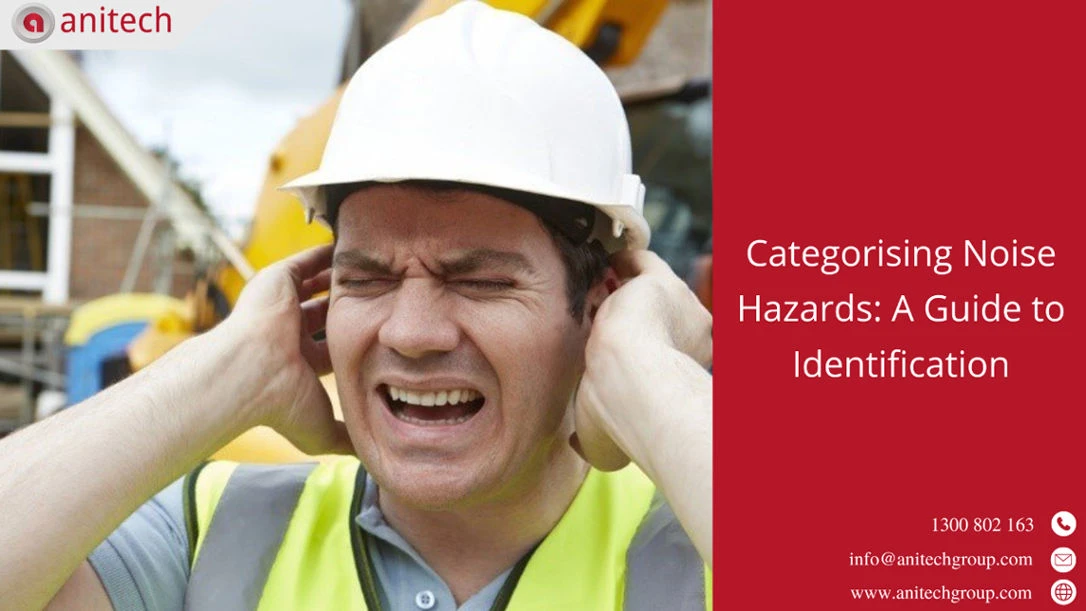
In the modern workplace, employee health and safety are paramount. Noise hazards are a significant concern in many Australian workplaces and can lead to hearing damage and other health problems if not managed properly.
To safeguard employees, it is essential to categorise and manage noise hazards according to Australian regulations and guidelines and promote occupational health and safety. In this blog post, we will explore this process in detail.
Noise Hazards
Noise hazards refer to potentially harmful sound levels encountered in workplaces. Such hazards commonly cause workers’ compensation claims and can pose a significant threat to employee health and safety.
Understanding Noise Hazards
Employers carry the pivotal responsibility of adhering to statutory mandates and instituting safe work protocols to mitigate noise exposure. In line with this, it is imperative for employers to formulate and put into action a comprehensive noise control policy and an accompanying program.
Furthermore, it’s paramount that all tiers of management, alongside employees, are well-informed about these control measures designed to curtail noise exposure. A significant facet of this responsibility for employees is their adherence to both statutory stipulations and established workplace procedures. Their cooperation in activities directed at safeguarding hearing health in the workplace is pivotal.
Effective noise management hinges on robust consultation and collaboration between employers, employees, and employee representatives. This synergy ensures the efficient execution of noise management measures.
To provide practical guidance on comprehending and mitigating workplace noise exposure, the National Code of Practice for Noise Management and Protection of Hearing at Work serves as a valuable resource. It’s worth noting that while the national standard specifies the maximum acceptable exposure levels for workplace noise, striving for lower noise levels whenever feasible is a prudent course of action.
Mitigating the risk of noise-induced hearing loss and other noise-related health effects can be executed through the implementation of measures like equipment and job redesign, comprehensive training, and vigilant maintenance practices. These collectively form a robust strategy for managing noise-related risks effectively.
Categorising Noise Hazards
The National Standard for Occupational Noise provides guidelines for categorising noise hazards in the workplace.
Factors to consider in this categorization process include frequency, intensity, duration of exposure, impact on health, and types of noise sources. This categorisation provides a foundation for assessing risk and implementing the appropriate control measures.
Noise hazards can be categorised based on the level of noise exposure and its potential impact on health and safety.
Noise hazards can be classified as low, medium, or high based on the noise levels measured in decibels (dB).
Categorisation helps in determining the appropriate control measures and interventions to mitigate the risks associated with noise exposure.
Identifying Noise Hazards:
Noise identification is crucial to identify individuals who may be exposed to excessive noise and assess their level of exposure.
- Consultation with employees, employee representatives, and those familiar with work processes is important in identifying noise hazards.
- A noise identification checklist can be used as a guide to identify noisy processes and tasks in the workplace.
- If a raised voice is needed to communicate with someone about one meter away, it indicates the need for a detailed noise assessment.
- Gathering information from plant manufacturers and suppliers can also provide insights into potential noise hazards.
Risk Control Measures:
Once noise hazards are identified, appropriate risk control measures should be implemented to manage the risks effectively.
Control measures may include equipment and job redesign, administrative controls, and the use of personal hearing protectors.
Regular checks should be conducted to ensure that administrative controls are being complied with.
The Australian/New Zealand Standard AS/NZS 12693 provides detailed guidance on administrative noise control measures.
Remember to tailor the content and methods of presenting the information to meet the specific needs of your target audience. Provide handouts and guidelines related to noise control, and emphasise the importance of consultation, cooperation, and training in the workplace.
Regulatory Framework in Australia
Australia’s regulatory framework for noise hazard management is primarily governed by the “Work Health and Safety Act 2011” and the “Work Health and Safety Regulations 2011.” These regulations underline the critical importance of preventing harm from exposure to workplace noise hazards. In addition to these primary regulations, Australian businesses need to be well-versed in the “National Code of Practice for Noise Management” and “Australian Standard AS 1269.”
Legislation and Standard
In accordance with the national model legislation (SWA, 2016), it is incumbent upon a person conducting a business or undertaking (PCBU) to ensure, to the extent reasonably practicable, the health and safety of workers (WHSA s 19). This duty obliges the elimination of risks to health and safety wherever reasonably achievable. In cases where elimination is not reasonably practicable, the focus shifts to minimizing these risks to the greatest extent possible (WHSA s 17). It’s worth noting that the Work Health and Safety legislation extends its reach to encompass designers, manufacturers, suppliers, and installers of machinery. Their responsibility lies in providing safe plants and necessary information for their secure usage. This requirement also extends to averting noise-induced hearing loss for the end user (see WHSR s 59).
Given the foreseeability of risks related to occupational noise-induced hearing loss, exposure limits are firmly established under health and safety and mining legislation. The Model Work Health and Safety Regulations (SWA, 2019) clearly outline exposure standards for noise, which include:
- LAeq,8h of 85 dB(A)
- LC,peak of 140 dB(C) (WHSR, s 56(1))
Compliance with these standards is essential for the safety and well-being of workers, and it’s the duty of PCBUs to uphold these regulations diligently.
- LAeq,8h signifies the eight-hour equivalent continuous A-weighted sound pressure level, denoted in decibels (dB(A)) and referenced to 20 micropascals. This is determined in accordance with AS/NZS 1269.1:2005, focusing on occupational noise management, specifically the measurement and assessment of noise immission and exposure.
- LC,peak is indicative of the C-weighted peak sound pressure level, expressed in decibels (dB(C)) and referenced to 20 micropascals. Similar to LAeq,8h, it is determined in accordance with AS/NZS 1269.1:2005, which concentrates on occupational noise management, encompassing the measurement and assessment of noise immission and exposure (WHSR s. 56(2)).
It’s important to recognise that these limits are set without accounting for any protection that might be provided by personal hearing protectors. Given the potential temporary hearing loss recovery time, the eight-hour equivalent exposure limit should be adjusted for extended shifts. For example, the Code of Practice suggests adding 1 dB(A) to the measured LAeq,8h dB(A) for shifts lasting “10 hours or more but less than 14 hours” (SWAa, 2018, p. 19).
The Code of Practice (SWA, 2018a) serves as a comprehensive resource, offering insights into noise and occupational noise-induced hearing loss (ONIHL). It outlines how to effectively manage risks and adhere to the regulated exposure limits. Additionally, the Australian/New Zealand Standard series AS/NZS 1269 Occupational Noise Management Set (SA/SNZ, 2005c) provides extensive information covering all aspects of noise assessment. This includes details on instrumentation, result evaluation, and noise management.
By closely adhering to the guidance in the Code of Practice and relevant sections of AS/NZS 1269, particularly Part 1, a person conducting a business or undertaking (PCBU) or any other responsible party should typically be well-equipped to demonstrate compliance with the regulated exposure standards. This diligent approach aids in the prevention of ONIHL.
Noise Hazard Assessment
Accurate assessment of noise hazards is a legal requirement in Australia. Employers must adhere to the stipulations of the Australian Standard AS 1269 when conducting workplace noise assessments. These assessments involve the use of sound level meters and dosimetry equipment. Engaging qualified audiometric officers is crucial for ensuring that assessments are precise and in compliance with Australian standards.
Control Measures
In Australia, noise hazard control measures follow a hierarchy, with eliminating or substituting noisy equipment as the primary objective. Engineering controls, which must adhere to AS 1269 requirements, are the next step in the hierarchy. Administrative controls involve implementing safe work procedures, as outlined in the National Code of Practice. Employers should also provide personal protective equipment, including hearing protection, in line with AS 1269.
Audiometric Testing
Audiometric testing plays a crucial role in identifying exposure to hazardous noise. According to WHSR (s 58), audiometric testing is mandated within 3 months of a worker commencing work and subsequently at least once every two years under certain circumstances:
- When a worker frequently relies on personal protective equipment to shield against the risk of hearing loss associated with noise surpassing the exposure standard.
- When personal protective equipment is supplied as a control measure.
Monitoring and Compliance
Regular workplace noise monitoring is a mandatory requirement as per AS 1269 Occupational Noise Management standard. Designated officers responsible for noise management must ensure ongoing compliance, as mandated by the Work Health and Safety Regulations 2011. Compliance with the regulations is crucial for maintaining a safe and productive work environment.
Training and Awareness Programs
Training programs and awareness campaigns are pivotal in creating a safe work environment. The “Code of Practice: Managing Noise and Preventing Hearing Loss at Work” specifies the need for these programs. Training should encompass various aspects of noise hazards, safe work practices, and the correct use of hearing protection equipment.
Employers are obligated to educate and inform employees about noise management to foster a safety-oriented workplace culture.
Thus, categorising and managing noise hazards is paramount for protecting the health and safety of employees. Australian businesses can ensure the well-being of their workforce and create safer and more productive workplaces.
For Australian SMEs, compliance with noise hazard regulations is not just a legal requirement but also a step towards fostering a culture of safety, which, in turn, can enhance overall business performance and employee well-being.
Our experienced occupational hygienists can help SMEs with noise assessments.
Do call us at 1300 802 163 or e-mail – sales@anitechgroup.com.


Recent Comments